Help a dyslexic child to focus and be motivated by setting goals.
Life goals are important because they help motivate a child to achieve.
Children who set life goals and achieve them are more likely to develop:
- a positive outlook on life
- better self-confidence
- higher self-esteem
A goal ladder is a simple way to motivate a dyslexic child. It is based on scientific research. Learn more: “Setting measurable goals with young people”.
Free 10-minute course
Help a dyslexic child get organised
Build independence and calmer mornings, in 3 short activities. 10 minutes a day, with free printable worksheets.
Try it today: build a mini goal ladder
- Pick a goal – ask your child to choose something small they would enjoy learning, like a new hobby.
- Draw 3 rungs – draw a short ladder. Write one small step on each rung, with the goal at the top.
- Colour it in – each time your child reaches a step, they colour in that rung. Give lots of praise.
Prefer a ready-made ladder? Print the free Goal Ladder worksheet, write the goal at the bottom, and colour in a rung for each step.

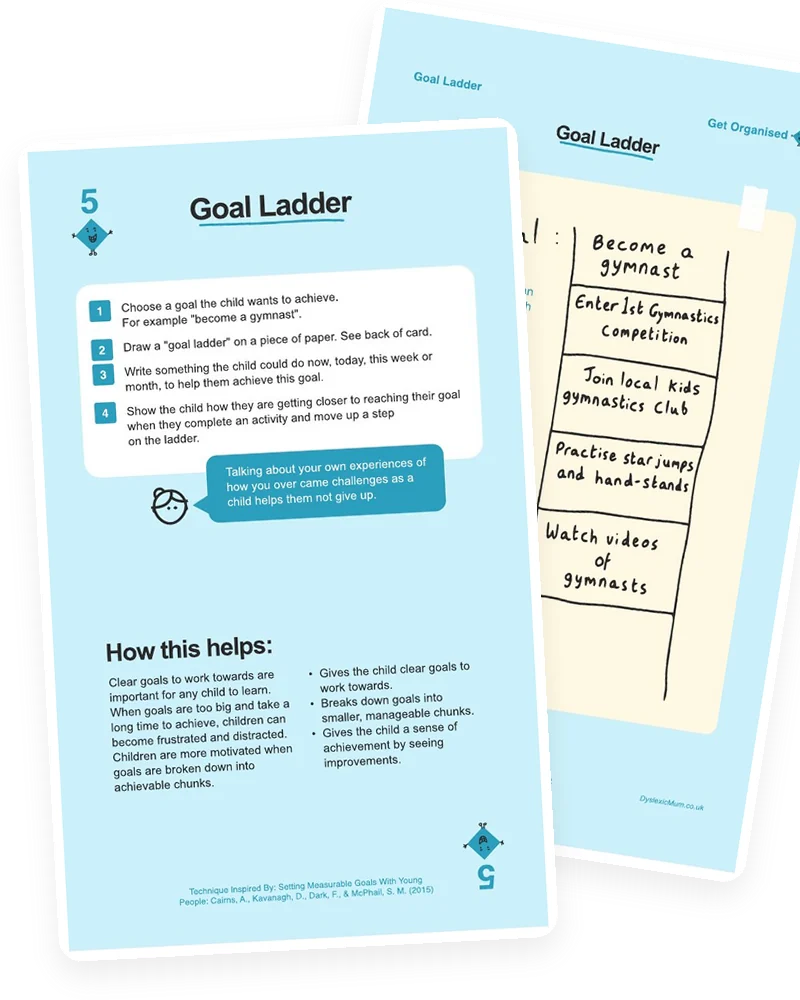
Want a ready-made goal ladder your child can fill in?
The Goal Ladder card has ready-made steps for you on the front and a picture ladder activity for your child on the back. Everything is in one place. It’s one of 56 ten-minute activities in the Mooki Cards deck.
Instant download · use on a phone or tablet, or print and fill in
Motivate a dyslexic child
Get advice from the Dyslexic Mum about how having clear goals can help to motivate a child:
“My grandmother always gave me great words of wisdom. She used to say, ‘Have ambition, have dreams. If you have a goal in life, you are more likely to achieve great things.’
My daughter has dyslexia. She loses interest in learning new skills, such as riding a bike, if she is unable to do them the first time. To be good at things takes practice and determination. Breaking goals down into manageable chunks, in the form of a goal ladder, helps to motivate her.”
Watch the video below, ‘Motivate a dyslexic child’, where the Dyslexic Mum shows how to make a goal ladder.
Use these top tips from the Dyslexic Mum when you make a goal ladder:
- Hobbies – start small. At first, work towards the child learning something they enjoy, such as a new hobby. It could be learning tennis or painting.
- Praise – build the child’s confidence by giving them lots of praise every time they reach a step on the goal ladder. The child could work towards a reward, such as a treat day out, or you could hold a mini award ceremony with homemade medals.
- Life goals – larger life goals, such as future jobs, are important for a child to have. Avoid overwhelming the child by planning too far into the future. Instead, work towards small goals. If they want to become a doctor, could they first learn the names of body parts?
To learn more about setting goals for motivation, see “Psychology of goal setting”.