Is your child’s writing full of back-to-front letters, missing words or spellings that change every time? Here are 6 signs of dyslexia to look for in a child’s writing, with real examples, and what to do next.
All children make mistakes when learning to write, and most get better with practice. A dyslexic child keeps making the same kinds of mistakes, even with lots of help, and may need extra support to improve their writing and spelling.
The signs in this article are based on scientific research, “Writing problems in developmental dyslexia”.
Free 10-minute course
Spot the signs of dyslexia
Know what to look for and what to do next, in 3 short activities. 10 minutes a day, with free printable worksheets.
Spot dyslexia signs in kids’ writing
Read how the Dyslexic Mum started to spot signs of dyslexia in her child’s writing:
“My child was happy at nursery and pre-school. She loved playing, made friends, and fit in with the other children. Then she started school, and things changed. It got serious. She needed to learn to read and write. This is when many parents, like me, notice their child seems different.
My child began to struggle with writing in class and needed extra help. I started to wonder, could it be dyslexia? Having clear examples of her writing that showed signs of dyslexia helped me when I spoke to the teachers and asked for more support.”
Watch the video “Dyslexia writing examples kids” below:
6 signs of dyslexia in a child’s writing
Here are 6 common signs of dyslexia to look out for in a child’s writing, with examples:
- Letters the wrong way round. Writes “b” instead of “d”, or “p” instead of “q”, long after classmates have stopped.
- The same word spelled in different ways. For example “dog”, “dgo”, “doog” and “bog”, all in one piece of writing.
- Missing letters or words. For example “t_ee” for “tree”, or leaving small words like “the” and “a” out of sentences.
- Letters in the wrong order. For example “was” written as “saw”, or “from” as “form”.
- Spelling by sound. Writing words the way they sound, like “sed” for “said” or “becos” for “because”.
- Messy or slow writing. Uneven letters, mixed capitals and lowercase, and writing that takes much longer than expected.
Dyslexia affects every child in a different way, so use these signs only as a guide. If you spot signs like these, speak to your child’s teacher. Give them three clear examples of why you believe your child is dyslexic, and ask them to help.
Try it today: collect 3 examples
- Gather (3 minutes). Find a few pieces of your child’s writing, from home or school.
- Look (5 minutes). Check each one for the 6 signs above. Circle any you spot.
- Keep (2 minutes). Put your three clearest examples in a folder, ready to show the teacher.
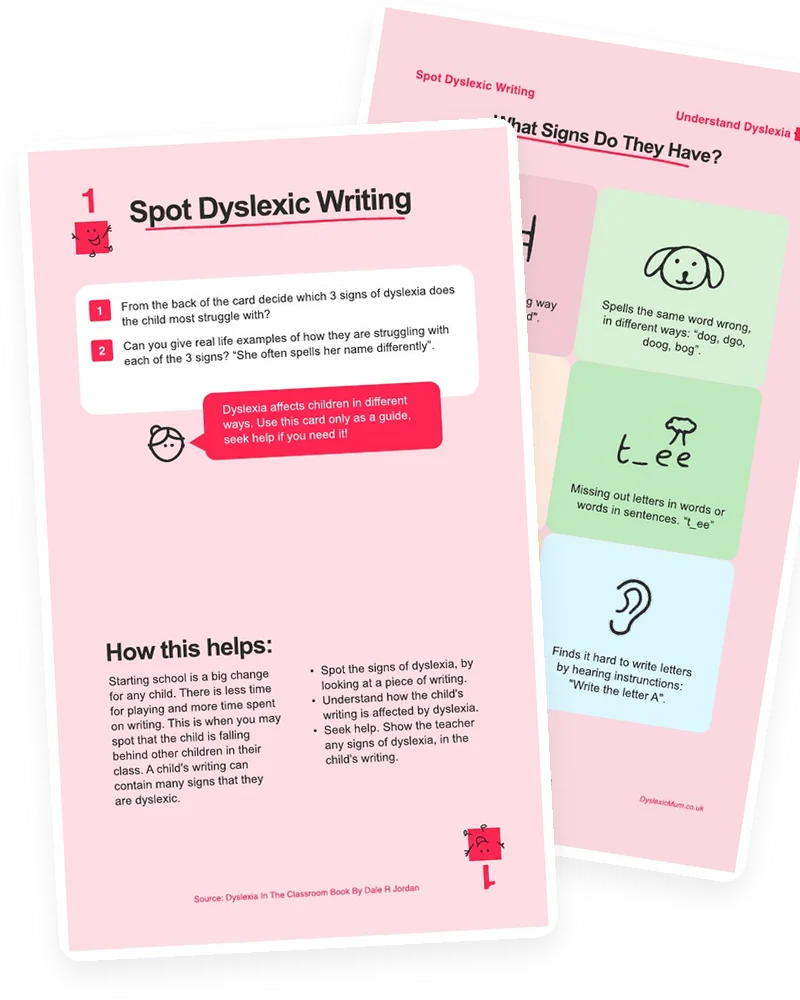
Want all the signs of dyslexic writing, in one place?
The Spot Dyslexic Writing card has ready-made steps for you on the front and a picture activity for your child on the back, with everything you need in one place. It’s one of 56 ten-minute activities in the Mooki Cards deck.
Instant download · use on a phone or tablet, or print and fill in
Could it be something more?
Messy, slow or painful handwriting can also be a sign of dysgraphia, a learning difference that affects writing. Read about the differences between dyslexia, dyspraxia, dyscalculia and dysgraphia.
If your child’s writing is rushed and full of careless mistakes because they find it hard to focus, read about the 3 types of ADHD. If they struggle to put their ideas into words when they talk, too, read about speech, language and communication needs.
Helpful articles
- Signs of dyslexia in 5 to 10 year olds
- Words that are hard for dyslexics to read and spell
- At what age should a child spell their name?
- Dyslexia symptoms (NHS)
- Spelling support for your child (British Dyslexia Association)
The bottom line
Back-to-front letters, changing spellings, missing letters and words, mixed-up letter order, spelling by sound and messy writing can all be signs of dyslexia. Collect 3 examples and share them with your child’s teacher. The Mooki Cards deck has 56 ten-minute activities, including Spot Dyslexic Writing, to help you spot the signs and support your child.