
Help a child aged 5-7+ to improve their handwriting.
All children learn to write by tracing over letters and words. This helps them remember the correct shape of letters and the spaces in words. This is a form of:
Many young children mirror write and learn to correct this. Mirror writing is a sign of dyslexia, especially if the child continues after the age of 7.
Tracing is based on scientific research. Learn more: ‘Mirror writing: neurological reflections’.
Free 10-minute course
Help a dyslexic child learn new spellings
Read, write and remember new words, in 3 short activities. 10 minutes a day, with free printable worksheets.
Try it today: trace one letter
Pick one letter your child finds hard to write, for example b. Then:
- Trace it – write the letter in dotted lines. Ask your child to trace over it slowly with a pencil.
- Write it alone – now ask them to write the letter on their own, with no dotted lines.
Keep it short and fun. Try the same letter again tomorrow.
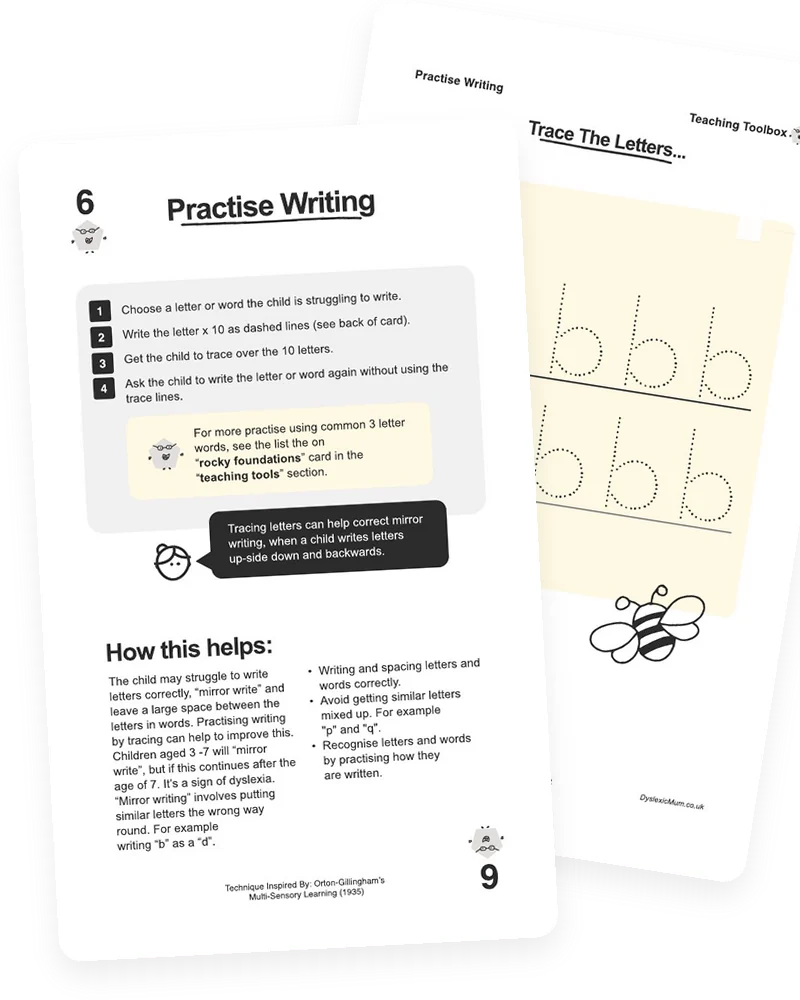
Want a ready-made tracing activity?
The Practise Writing card has simple step-by-step instructions for you on the front and a ready-made tracing picture activity for your child on the back. Everything is in one place. It’s one of 56 ten-minute activities in the Mooki Cards deck.
Instant download · use on a phone or tablet, or print and fill in
Dyslexic writing signs
Get advice from the Dyslexic Mum on how tracing letters can help a child to improve their writing:
“One of the first signs I noticed in my child’s writing, that made me think she had dyslexia, was mirror writing. She would mirror write certain letters in words. I spoke to her teachers about this, saying I thought she had dyslexia. They told me that many young children mirror write and it corrects itself. Yet if she was still doing it after age 7, this could be a sign of dyslexia.
To help my child write her letters, I got her to practise tracing over the top of letters and words. This first helped her learn how to write her name correctly. Now we use tracing if she is struggling to spell words. It helps her remember.”
To spot other signs of dyslexia in a child’s writing, read “Spot dyslexia in child’s writing, look for 6 signs”.
Watch the video ‘Trace letters’ below. The Dyslexic Mum shares tips on helping children to practise writing:
Follow these tips when your child practises tracing letters:
- Is your child dyslexic? Mirrored writing is a sign of dyslexia. If you think your child has dyslexia, talk to their teacher for advice.
- Mirrored letters: Children often mirror the letters “b, d, p, and q”. When practising these letters, include them in words. This helps the child remember which way round they go.
- Spelling help: My child mirrored letters during spelling tests and was marked down. If this happens to your child, speak to the teacher. Ask if they can relax the rules.