Understand dyslexia assessments. Learn what they include and how having an assessment can help a dyslexic child.
A child may need a formal dyslexia assessment before they can get extra help at school. These dyslexia tests can be expensive and the process confusing.
To learn more about organising a formal dyslexia assessment for your child, read our Ultimate guide to dyslexia assessments.
Here are answers to some common questions about dyslexia assessments. They can help you decide if a formal test is right for you and the child.
Free 10-minute course
Spot the signs of dyslexia
Know what to look for and what to do next, in 3 short activities. 10 minutes a day, with free printable worksheets.
What age can a child be tested and assessed for dyslexia?
A child cannot be formally assessed for dyslexia until they are aged 7. Yet they can have an informal dyslexia screening test from the age of 5.
Screening tests are informal, usually done at school via an online dyslexia test. They can be inaccurate, so a formal dyslexia assessment is much better.
How do you get a child assessed for dyslexia?
To get a child assessed for dyslexia, you will need to organise a formal dyslexia assessment.
These assessments can only be done by trained professionals. A formal dyslexia assessment may result in a formal dyslexia diagnosis.
The formal assessment will also show if the child has another similar learning difficulty, such as Dysgraphia, Dyscalculia or Dyspraxia.
- What is a Formal Dyslexia Assessment? It is a test to assess if a child or adult has dyslexia. If they do, they will get a formal dyslexia diagnosis.
- Who can do the Dyslexia Assessment? It can only be done by a trained professional, such as an Educational Psychologist.
- How much does a dyslexia assessment cost? It is expensive and can cost on average £500+.
- How does a dyslexia assessment help a child? A formal dyslexia diagnosis means the child is legally entitled to extra help at school.
To learn more about formal dyslexia assessments, see “NHS Dyslexia Diagnosis”.
How can I get my child tested for dyslexia?
Dyslexia tests for children provide a diagnosis of dyslexia. These tests are often organised privately and done by a qualified assessor.
The assessments include recommendations for how the school can support the child’s learning. However, they can be costly and hard for many families to access.
Are formal dyslexia assessments worth it?
Dyslexia assessments are expensive and usually have to be arranged privately. There are many pros and cons to dyslexia assessments.
Here are answers to common questions to help you decide if your child should get a formal dyslexia assessment:
- Do they need a formal diagnosis? If a child struggles in class, they should get extra support, even without a formal dyslexia diagnosis.
- Is the test worth it? If the child gets extra help, a dyslexia test may not be needed. Learning depends on teacher support and the right help.
- What dyslexia help can they get? If the child has dyslexia, the test will suggest ways teachers can help. This is known as making “Reasonable Adjustments.”
- What can the child get funding for? Dyslexia support funding for equipment like computers and books is often available in colleges or universities, but not in UK schools.
- Does the child get an EHCP after this assessment? The child is not automatically given an “Educational Health Care Plan”. Getting this plan is a long process, organised by your LEA.
Contact dyslexia associations in your county to organise a formal dyslexia assessment. In the UK, contact “The British Dyslexia Association”.
Watch the clickable video below, where the Dyslexic Mum discusses the ‘pros and cons of formal assessments’.
Not sure if an assessment is right for your child?
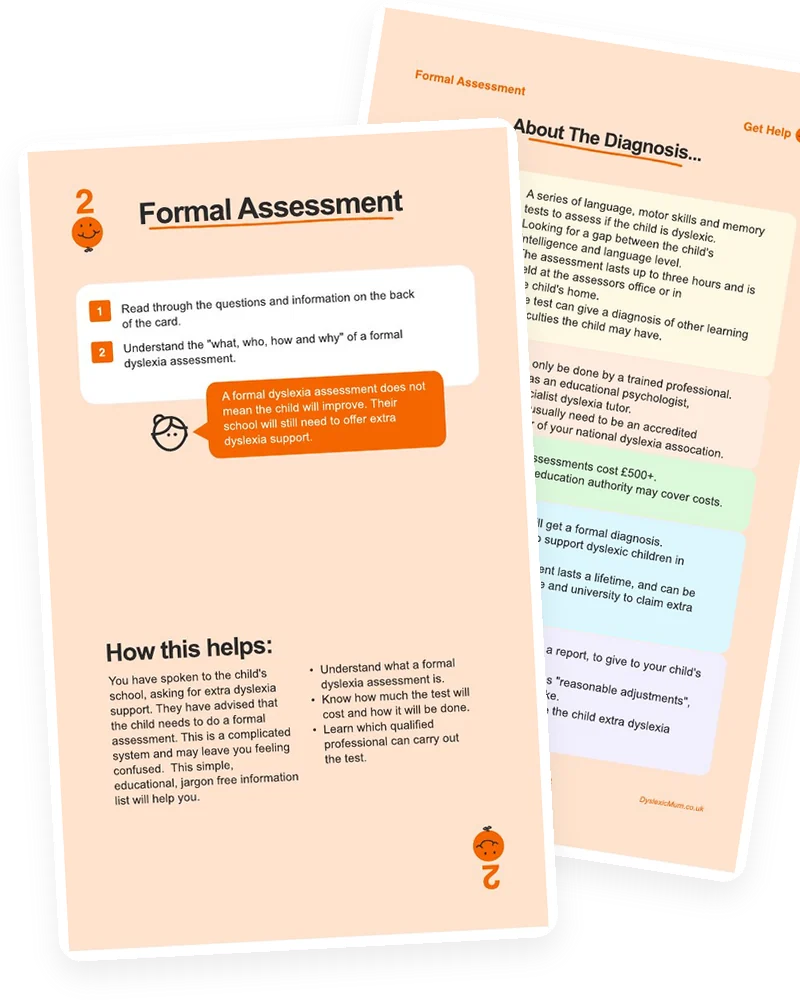
The Formal Assessment card has ready-made steps for you on the front and a picture activity for your child on the back, so everything you need is in one place. It’s one of 56 ten-minute activities in the Mooki Cards deck.
Instant download · use on a phone or tablet, or print and fill in
Dyslexia articles
For more helpful information about dyslexia assessments, see the articles below: