
Is your child stuck on the same little words every time they read? Here are the 100 most common words in children’s books, the ones every dyslexic child needs to learn, with tips and a 10-minute game to help them stick.
These 100 words make up about half of all the words children read in books. So once your child knows them, they can read much more of every page, and reading feels less like hard work.
Teaching these words is based on research into the words that appear most often in children’s books. Learn more: “Early reading research, University of Warwick”.
Free 10-minute course
Help a dyslexic child learn new spellings
Read, write and remember new words, in 3 short activities. 10 minutes a day, with free printable worksheets.
The 100 most common words
Here are the 100 high-frequency words, from the most common to the least:
Words 1–20: the, and, a, to, said, in, he, I, of, it, was, you, they, on, she, is, for, at, his, but
Words 21–40: that, with, all, we, can, are, up, had, my, her, what, there, out, this, have, went, be, like, some, so
Words 41–60: not, then, were, go, little, as, no, mum, one, them, do, me, down, dad, big, when, it’s, see, looked, very
Words 61–80: look, don’t, come, will, into, back, from, children, him, Mr, get, just, now, came, oh, about, got, their, people, your
Words 81–100: put, could, house, old, too, by, day, made, time, I’m, if, help, Mrs, called, here, off, asked, saw, make, an
In the US, swap “mum” for “mom”.
Try it today: 5 words this week
- Pick 5 common words (2 minutes). Choose short words from the list that come up again and again in your child’s reading book, like “the”, “and” or “said”.
- Check what they know (3 minutes). Can your child read each word? Can they write it?
- Practise the gaps (5 minutes a day). Spend a few minutes each day this week on the words they don’t know yet. Write them in sand, make them with play dough, or hunt for them in a book.
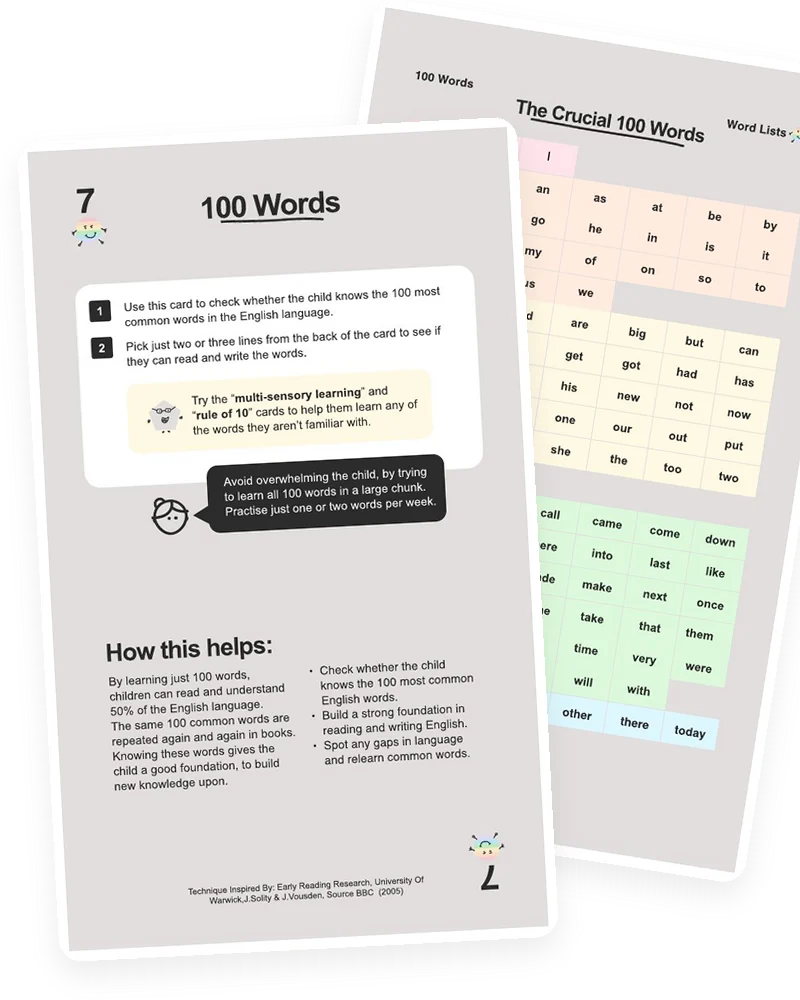
Want all 100 words on a card your child can use?
The 100 Words card has the full list in one place, with ready-made steps for you on the front and a picture activity for your child on the back. It’s one of 56 ten-minute activities in the Mooki Cards deck.
Instant download · use on a phone or tablet, or print and fill in
Watch the video below: “100 words that can help dyslexic children read better”.
What are the first words children learn to read?
Sight words are usually the first words a child learns to read and write at school.
The 100 most common words are often called high-frequency words or sight words. Teaching them helps dyslexic children read and write with more confidence.
Some of these words are tricky words, like “said”, “was” and “the”. They are hard to read because they can’t easily be sounded out, so children need to learn them by sight.
What words should a 5 year old know?
By age 5, most children understand thousands of spoken words. But understanding a word is different from being able to read, write and spell it.
The first words children learn to read and write are high-frequency words, like the 100 words above. Most 5 year olds are just starting to read a few of these by sight.
How to teach a dyslexic child the 100 words
Start teaching your child the 100 most common words with these tips:
- Check what they know. Find out which words your child can already read and write.
- Spot the gaps. Then work towards reading and writing all 100 words.
- Start slow. Don’t overwhelm your child. Focus on just 5 words a week.
- Make it multi-sensory. Use multi-sensory learning and muscle memory to help words stick.
- Keep it fun. Use 10-minute games, like those in the Mooki Cards deck.
Could it be something more?
Lots of children take time to learn these words. But if your child still can’t remember common words after lots of practice, check the signs of dyslexia in 5 to 10 year olds. If they also find it hard to understand or use spoken words, read about speech, language and communication needs.
More helpful articles
- High frequency words: 200 words to help dyslexic children read
- Words that are hard for dyslexics to read and spell
- 18 dyslexia reading aids
- 200+ free phonics worksheets
The bottom line
The 100 most common words make up about half of what children read. Teach them 5 at a time, in fun, multi-sensory ways. The Mooki Cards deck has 56 ten-minute activities, including the 100 Words card, to help your child read with confidence.