If you’re wondering whether your child has a speech and language delay, this guide explains what it means, the signs to look for at each age, and when to ask for help.
It’s natural to compare your child with others at nursery or the park. Some children chatter away at 18 months, while others say very little until well after their second birthday. So how do you know if your child is just taking their time, or needs some support?
What is a speech and language delay?
A speech and language delay means a child is developing talking and understanding in the usual order, but more slowly than most children their age.
You might also hear the term language disorder. Professionals use this when a child’s language is developing differently, not just later, or when difficulties carry on over time. A speech and language therapist can help work out which describes your child best. Often, it only becomes clear as a child grows.
Either way, a delay is not a sign of low intelligence, and it’s not caused by anything you did wrong.
What is a late talker?
A “late talker” is a toddler who is slow to start using words but is otherwise developing well. They usually understand a lot, play well and use gestures like pointing and waving.
Late talking is common. The American Academy of Pediatrics says that around 1 in 5 children learn to talk or use words later than other children their age. Some simple delays are temporary, but others need support, which is why it’s worth keeping an eye on things rather than simply waiting.
Causes of speech and language delay
Often, there is no single clear cause. The AAP and the NIDCD list some things that can play a part:
- Hearing problems. Hearing loss can make it harder to learn speech. The NHS notes that long-lasting glue ear can affect speech development.
- Family history. Speech and language difficulties can run in families.
- Other developmental differences, such as autism or a learning disability.
Learning two languages is not a cause for worry. In fact, the NHS says learning more than one language can help a child’s English, so keep using whichever language feels natural at home.
Signs of delayed speech and language development: age by age
The CDC’s milestones are set at the age by which at least 75% of children reach each skill, so missing one is a reason to ask, not to panic. Speak to a professional if your child:
| Age | Signs to talk to someone about |
|---|---|
| By 12 months | Not babbling, not looking when you call their name, not using gestures like waving bye-bye |
| By 18 months | Not trying to say at least three words besides “mama” or “dada”, or not following simple instructions like “Give it to me” |
| By 2 years | Using only a few words, not joining two words together, or not pointing to things in a book when asked |
| By 3 years | Hard for people outside the family to understand, not asking simple questions, not taking turns in a short chat |
| Any age | Losing words or skills they used to have, or getting very frustrated when trying to communicate |
If your child loses skills they had before, don’t wait: contact your GP, health visitor or paediatrician promptly.
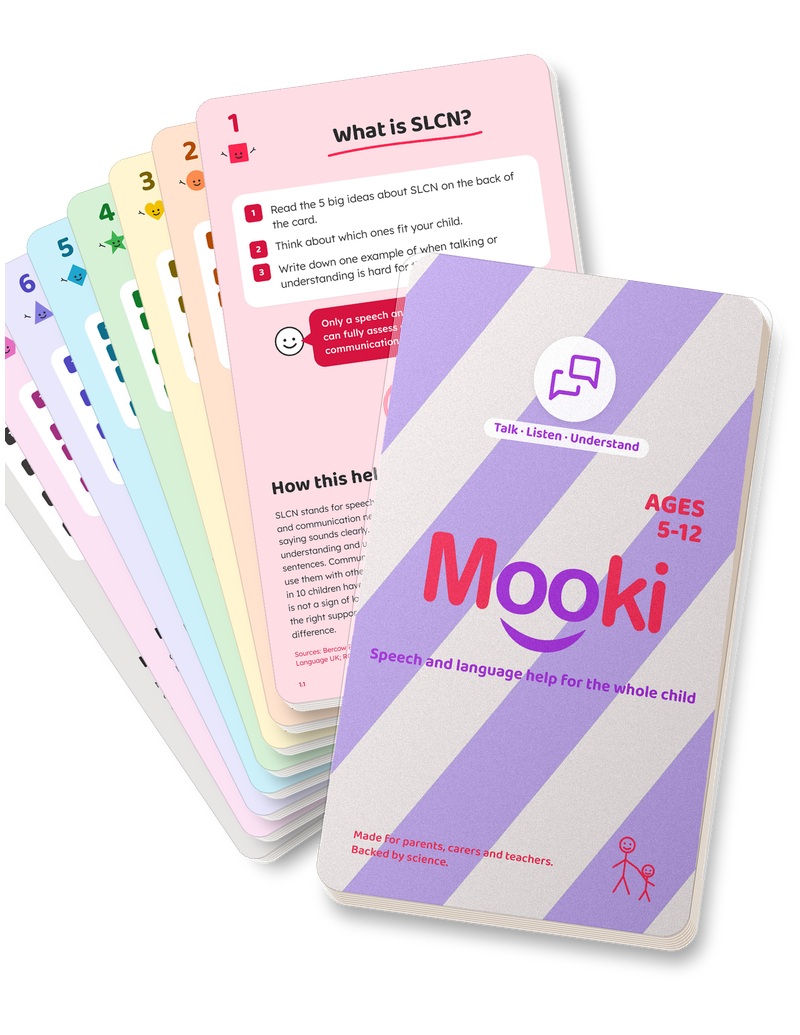
Worried your child is a late talker?
Spot the Signs helps you check your child's talking against simple milestones, and Wait and Listen gives them more chances to talk. It's one of 56 ten-minute activities in the Speech and Language deck.
Instant download · use on a phone or tablet, or print and fill in at home or school
Try it today: 10 minutes of “wait and listen”
Many loving adults talk a lot for a child who doesn’t say much. It’s kind, but it can leave little space for the child to try. This game gives your child that space.
- Choose a fun activity your child likes, such as bubbles, a snack or a wind-up toy.
- Pause before giving it. Hold up the bubbles and look at your child expectantly.
- Wait for 5 to 10 seconds. Count slowly in your head. Resist the urge to fill the silence.
- Accept any attempt. A look, a point, a sound or a word all count. Respond warmly straight away.
- Model the word. “Bubbles! You want bubbles!” Then blow them.
Repeat several times. Over the days, you may notice your child starting to fill the pause with sounds or words.
What to do next if you’re worried
In the UK
- Talk to your health visitor or GP. They can check your child’s development and refer them on. The NHS says you can also refer your child to speech and language therapy yourself.
- Ask for a hearing test. It’s a sensible first check for any child who is slow to talk.
- Talk to nursery or school. Staff can share what they see, and the SENCo can put support in place.
In the US
- Talk to your pediatrician. They may use a checklist, observe your child and order a hearing test.
- Contact Early Intervention. For children under 3, your state’s Early Intervention program offers evaluations, and services are free or low-cost for children who qualify. You don’t need a doctor’s referral.
- From age 3, contact your local public school district to ask for an evaluation.
If a doctor says your child will “catch up” but you’re still worried, it’s fine to ask for a second opinion or a referral to a speech and language specialist.
The bottom line
A speech and language delay is common, and many children make great progress with the right support. Trust your instincts, check hearing, and don’t be afraid to ask early. In the meantime, slow down, wait, and give your child lots of chances to talk. Every small step counts.