If your child has a speech and language assessment coming up, this guide explains what happens, how to prepare your child, and how to make sense of the report afterwards.
Waiting for an assessment can make parents nervous. Will my child cooperate? What are they testing? What if they don’t talk at all? The good news is that therapists are very used to shy, wriggly and chatty children alike, and most assessments feel like play.
What is a speech and language assessment?
A speech and language assessment is a careful look at how your child understands, talks and communicates. In the UK it is done by a speech and language therapist (SLT). In the US, it’s often called a speech and language evaluation and is done by a speech-language pathologist (SLP).
The aim is to find out:
- what your child does well
- what they find hard
- whether they would benefit from therapy or other support
- what kind of help would work best
Screening vs a full assessment
A speech and language screening is a quick check, often done at nursery, school or a health review. It flags children who might need a closer look. A screening test can’t diagnose anything on its own.
A full assessment takes longer and looks at all areas of communication in detail.
What does a speech and language assessment look at?
Every assessment is tailored to the child, but ASHA’s guidance for therapists gives a good idea of what may be included:
- Case history. Questions about your child’s development, health, ear infections, family history and the languages spoken at home.
- Hearing. The NIDCD notes that an evaluation often includes a hearing test, because hearing problems can affect speech and language.
- Speech sounds. Naming pictures and chatting, so the therapist can hear which sounds your child says and how clear they are.
- Mouth movements. A quick look at how the lips, tongue and jaw move.
- Understanding. Following instructions, pointing to pictures, answering questions.
- Talking. Vocabulary, sentences and telling a story.
- Social communication. Turn-taking, gestures, play and conversation.
Formal tests and informal assessment
A speech and language test may be formal (standardised). That means your child does set tasks and their scores are compared with other children of the same age.
An informal speech and language assessment is more like guided play. The therapist watches, listens and chats with your child, and may also visit them at nursery or school. Most good assessments use both, plus your own knowledge of your child.
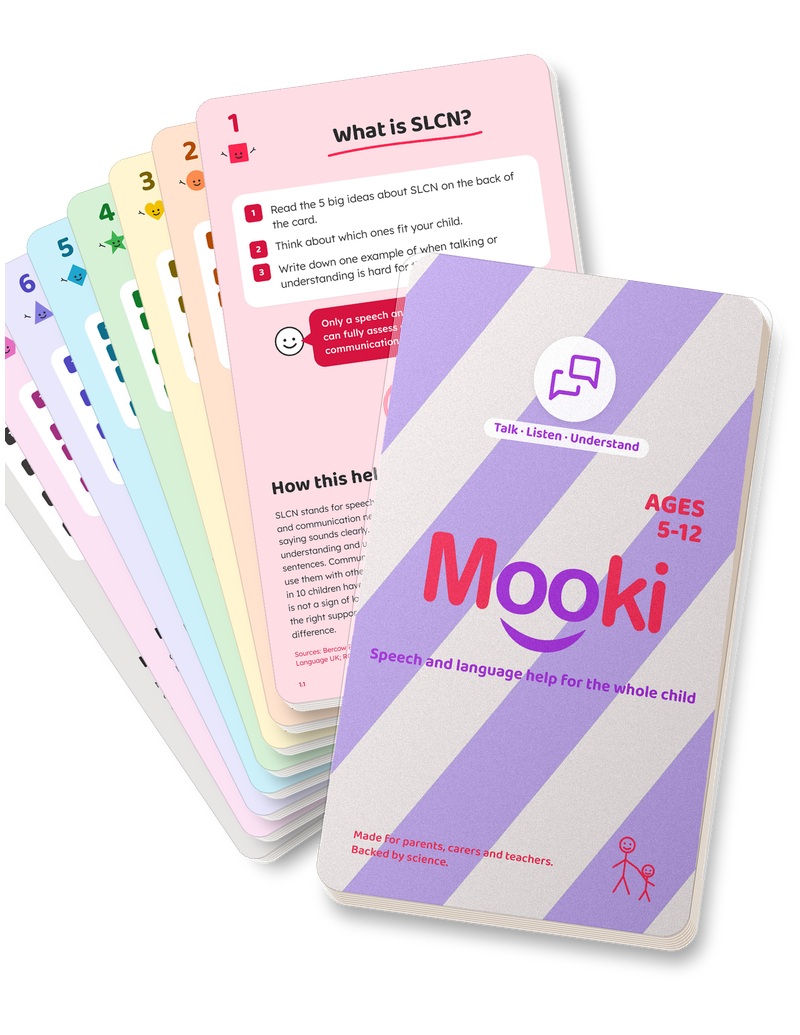
Feeling ready for your child's assessment?
The Getting Assessed card helps you prepare your notes and questions, and Talk Detective helps you spot what your child finds easy or hard. It's one of 56 ten-minute activities in the deck.
Instant download · use on a phone or tablet, or print and fill in at home or school
How to prepare your child
Try it today: a 10-minute “what to expect” chat
A few days before the appointment, try this.
- Explain simply. “We’re going to see Sarah. She helps children with talking. You’ll play games and look at pictures.”
- Role-play. Play “talking games” at home: name some pictures, follow a few silly instructions, tell a short story.
- Pack a comfort item. A favourite toy or snack can help.
- Keep it low pressure. Avoid saying “it’s a test” or “do your best talking”. There are no right or wrong answers.
What to bring
- notes of words your child uses and examples of what’s hard
- any reports from nursery, school, a health visitor or doctor
- a short video of your child talking at home, if they are likely to be shy
- a list of your questions
Don’t worry if your child doesn’t perform as usual on the day. Tell the therapist, and they will take it into account.
Reading the speech and language assessment report
After the assessment, you’ll usually get a written report. It may feel full of jargon at first. Look for these parts:
- Background: what you and others shared about your child.
- Results: what was tested and how your child did. Standardised scores may be shown as standard scores, percentiles or age equivalents.
- Summary: the therapist’s view of your child’s strengths and needs. This may include a diagnosis, such as developmental language disorder (DLD) or a speech sound disorder, or not.
- Recommendations: what should happen next, at home and at school.
Tips for understanding the report
- Percentiles tell you how your child compares to others. The 50th percentile is right in the middle.
- Ask questions. It is completely fine to ask the therapist, “What does this mean for my child day to day?”
- Share it with school. The recommendations are most useful when teachers know about them.
Assessments, school support and the law
UK
NHS assessments are free. You can ask your GP, health visitor or school for a referral, or self-refer in many areas. The RCSLT explains how to find a speech and language therapist, including independent therapists. If you apply for an EHC needs assessment, the council may ask for reports from professionals who know your child, so keep copies of any SLT reports.
US
For children under 3, contact your state’s Early Intervention program for an evaluation. Services are free or low-cost for children who qualify. From age 3, ask your public school district for an evaluation in writing. The American Academy of Pediatrics explains that children who qualify may get an IEP. Under IDEA, a school evaluation must assess all areas of suspected disability.
The bottom line
A speech and language assessment is a chance to understand your child better, not a test they can pass or fail. A little preparation helps your child feel relaxed, and your notes and questions make the results much more useful. If you’re worried at any point, talk to your GP or paediatrician, or your child’s school.