
If you care for a 3 to 5 year old and wonder whether their number skills are on track, this guide is for you. You’ll learn the early signs of dyscalculia to look out for, what is perfectly normal at this age, and playful activities to try at home.
Young children develop at very different rates. A preschooler who mixes up their numbers is usually just learning. But some early number difficulties are worth noticing, because a little extra play and support now can make a real difference later.
Free 10-minute course
Build number sense with dyscalculia
Make numbers feel real, in 3 short activities. 10 minutes a day, with free printable worksheets.
Can you spot dyscalculia in young children?
Dyscalculia is a specific learning difficulty that affects how children understand numbers. It’s usually identified once a child is at school and maths gets more formal. But the roots of dyscalculia lie in early number sense, so clues can appear much earlier.
Understood points out that maths difficulties can show up before a child starts formal maths lessons. Early signs aren’t a diagnosis. They’re a reason to watch, play and support.
The building blocks of early number sense
To understand the early signs, it helps to know what young children are learning. The Education Endowment Foundation’s early maths guidance describes several key skills.
Subitising
Subitising means seeing how many things there are without counting. Most young children can quickly recognise small groups of up to about four. Think of how you “just know” the dots on a dice.
Counting one-to-one
This means touching or pointing to each object once, while saying one number word. Young children often skip objects or count one twice, and that’s normal at first.
Knowing “how many”
After counting, children learn that the last number they say tells you the total. So if you count “1, 2, 3, 4, 5”, there are five. This is called the cardinal principle, and it’s a big step.
Comparing amounts
This means seeing which group has more or fewer, and later, which number is bigger.
Linking numbers, words and amounts
Children gradually connect the word “three”, the numeral 3 and a group of three things.
Early signs of dyscalculia to look out for
On their own, these signs are common in young children. What matters is when several appear together, and keep going well after other children the same age have moved on.
Age 3 to 4 (preschool or nursery)
- Has real trouble learning to say numbers in order, even to 5.
- Shows little interest in counting songs, rhymes or number games.
- Finds it hard to match one object to one number word.
- Doesn’t notice when a small group gets bigger or smaller.
Age 4 to 5 (Reception in the UK, pre-K or kindergarten in the US)
- Can say numbers in order but can’t use them to count objects.
- Counts a group of things but can’t tell you how many there are.
- Hands you a whole pile when you ask for “three blocks”.
- Needs to count tiny groups of 2 or 3, rather than seeing them at a glance.
- Can’t tell which of two groups has more, such as 2 sweets or 6 sweets.
- Struggles to link the written number 4 to four objects.
- Finds sorting or ordering by size hard, such as smallest to biggest.
Understood’s guide to signs at different ages also describes young children who skip over numbers when counting, long after others their age can say them in the right order.
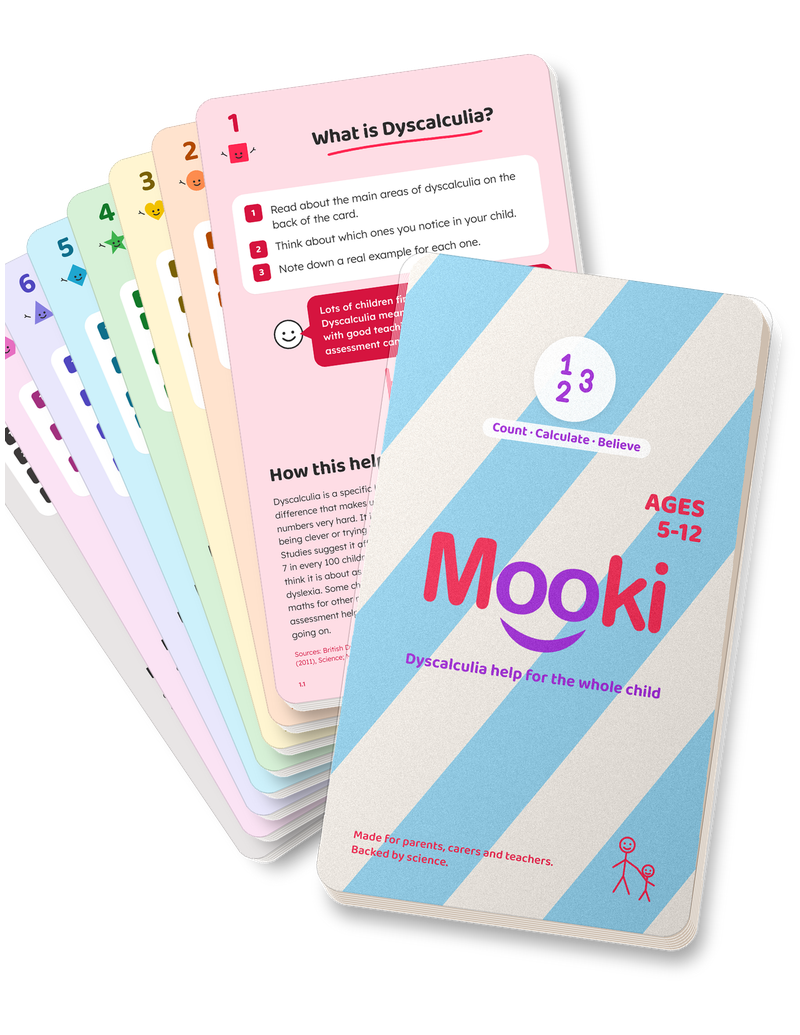
Playful number games for little learners
Quick Look builds seeing amounts at a glance, Count It Out practises careful counting, and Bigger or Smaller grows comparing skills. Each is one of 56 ten-minute activities in the Mooki Cards dyscalculia deck.
Instant download · use on a phone or tablet, or print and fill in at home or school
Number sense problems in toddlers: what’s normal?
Parents of toddlers sometimes worry too. For children under 3, it’s normal to:
- Say numbers in a jumble, like “1, 2, 5, 9”.
- Use “two” to mean “more than one”.
- Not yet understand counting.
At this age, number sense is just starting to grow. Lots of everyday talk about “more”, “one”, “two” and “all gone” is all a toddler needs. Early dyscalculia signs only become clearer as children reach 4 and 5.
Try it today: three 10-minute number games
These simple activities build exactly the skills listed above. Choose one, keep it light, and stop while it’s fun.
1. Peekaboo dots (subitising)
- Put 1 to 4 small objects, like buttons or raisins, under a cup.
- Lift the cup for a moment, then cover them again.
- Ask: “How many did you see?”
- Lift the cup and check together.
2. Teddy’s tea party (counting one-to-one)
- Set out some toys and ask your child to give each toy one biscuit.
- Count them together, touching each one.
- Ask: “How many biscuits did we give out?”
- If your child counts again from the start, that’s fine. Gently say “Five. The last number tells us how many.”
3. Who has more? (comparing)
- Make two small piles of grapes or crackers, such as 2 and 5.
- Ask: “Which pile has more? How do you know?”
- Make the piles closer, like 4 and 5, as your child gets better.
- Let them eat the bigger pile if they’re right.
Why board games help
Simple board games with numbered squares in a straight line, like Snakes and Ladders, are great for young children. In one well-known study, preschoolers who played a simple numbered board game for four 15-minute sessions over two weeks got better at ordering numbers and estimating where they belong on a number line, compared with children who played a similar game using colours.
Count each square out loud as you move: “I’m on 4. I rolled 2. 5, 6!” This helps children feel that bigger numbers are further along.
What to do if you’re worried
- Keep notes of what you see over a few weeks.
- Talk to your child’s key person or teacher. In England, early years settings follow the Early Years Foundation Stage, and children have a progress check at age 2 and an assessment in Reception, as set out on gov.uk.
- In the UK, if your child is in school, ask to talk to the SENCo. If not, talk to your health visitor or GP.
- In the US, talk to your child’s preschool teacher or pediatrician, and ask what early support is available where you live.
Remember: an early sign isn’t a label. Many children simply need more time and more playful practice.
Playful, ten-minute activities, like those in Mooki Cards, are an easy way to keep number games going at home.
The bottom line
The early signs of dyscalculia show up in basic number skills like seeing small amounts, counting and comparing. Young children vary a lot, so watch for patterns over time rather than one-off muddles. Lots of everyday number play, simple board games and a calm chat with your child’s setting are the best first steps.