
Wondering whether your child needs a dyscalculia test? This guide gives you a simple home checklist to fill in first, then explains what school screening and a formal assessment really involve in the UK and the US.
There’s no reliable online dyscalculia test that can diagnose your child. What you can do at home is notice patterns and write them down. That information is gold when you talk to school, and it helps make sure your child gets the right kind of help.
Free 10-minute course
Build number sense with dyscalculia
Make numbers feel real, in 3 short activities. 10 minutes a day, with free printable worksheets.
Can you do a dyscalculia test at home?
Not a real one. A diagnosis needs a trained assessor, a range of tests and a look at your child’s whole learning history. Quick online quizzes can’t do that, and they can worry you without good reason.
What you can do is spot red flags. Think of the checklist below as a way to organise your observations, not a score. It will help you have a clearer, calmer conversation with your child’s teacher.
A parent checklist: number skill red flags
Tick anything you have noticed often over at least a few weeks. Think about what’s expected for your child’s age, and compare with other children of the same age if you can.
Number sense
- Finds it hard to say which of two numbers is bigger, such as 6 or 9.
- Can’t see small amounts (up to 4 or 5) without counting them one by one.
- Loses track when counting objects, or skips and repeats them.
- Struggles to estimate, such as guessing roughly how many sweets are in a small bowl.
Number facts and calculation
- Still counts on fingers for simple sums when classmates have moved on.
- Learns a number fact one day and seems to have lost it the next.
- Finds it very hard to count backwards or count on from a number.
- Mixes up + and – signs, or isn’t sure which one to use.
Place value and written numbers
- Writes numbers back to front or in the wrong order, such as 31 for 13.
- Isn’t sure what the “1” in 15 really stands for.
- Gets lost lining up numbers in columns.
Everyday maths
- Finds money, change or prices confusing.
- Struggles to tell the time or judge how long things take.
- Finds following directions, scores in games or page numbers hard.
Feelings and behaviour
- Gets upset, angry or quiet when maths comes up.
- Avoids board games, card games or anything with numbers.
- Says things like “I’m stupid” or “I can’t do maths”.
What do the ticks mean? Several ticks across more than one section, lasting for months despite good teaching, is a good reason to talk to school. A few ticks, or ticks only when your child is tired or worried, may simply be part of normal learning. Either way, your notes are useful.
What is a dyscalculia screener?
A dyscalculia screener is a short check, often done by a teacher or SENCo, sometimes on a computer. It looks for signs that a child might need a fuller assessment.
The British Dyslexia Association explains that screening and informal assessment are different from a formal diagnosis. An informal assessment shows where a child’s difficulties lie, so support can be planned. A screener simply flags who may need a closer look.
A dyscalculia screening test can’t give a diagnosis. It’s a first step, and a useful one.
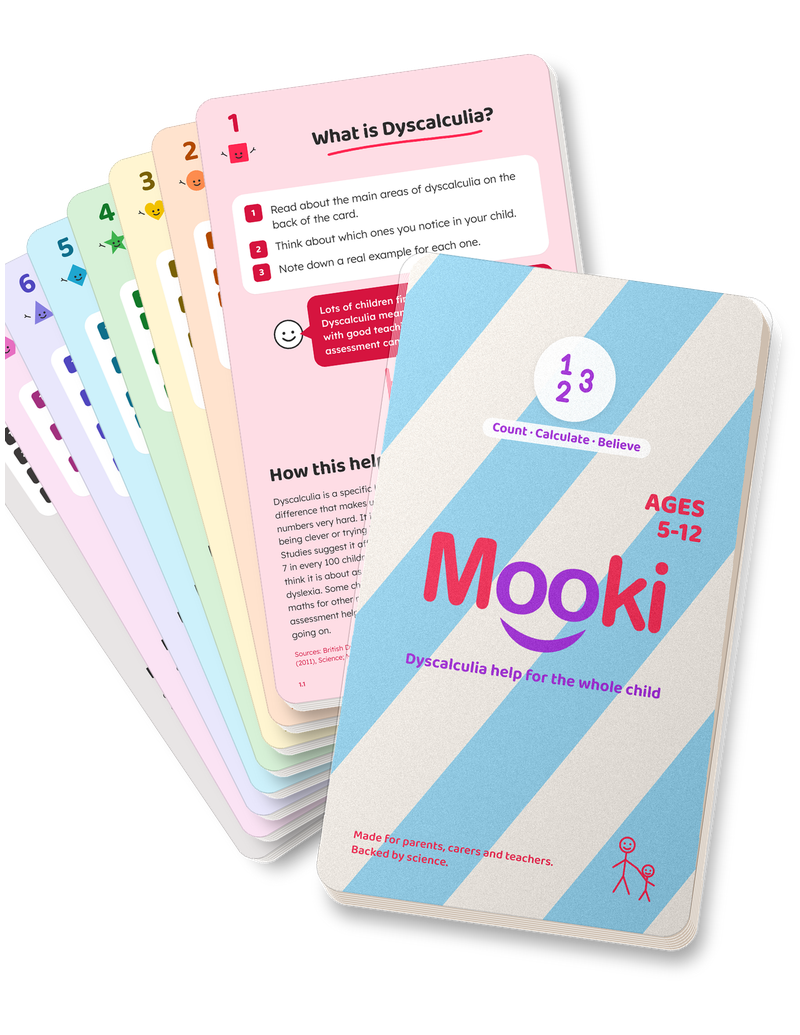
Something positive to do while you wait
Try Maths Detective to see where your child's number skills are secure, then Getting Assessed and Talk to School to plan next steps. Each is one of 56 ten-minute activities in the Mooki Cards dyscalculia deck.
Instant download · use on a phone or tablet, or print and fill in at home or school
What a formal dyscalculia assessment involves
A full assessment is much more detailed than a screener, and it may be split into sessions with breaks. The assessor will typically:
- Ask you and the school about your child’s history, strengths and worries.
- Look at basic number skills, such as comparing numbers, counting and estimating.
- Check calculation, number facts and problem solving.
- Look at related skills, such as memory, processing speed and reading.
- Watch how your child works, not just whether answers are right.
- Write a report with findings and practical recommendations.
In the UK
Most dyscalculia assessments are done by a specialist teacher or an educational psychologist. The British Dyslexia Association recommends using an assessor with a level 7 qualification in assessment and a specific dyscalculia qualification. Dyscalculia isn’t classed as a medical condition, so the NHS doesn’t usually assess for it.
Private assessments cost money. For example, the BDA lists its own dyscalculia assessment (for children and adults) at £690 including VAT at the time of writing. Other providers’ prices vary.
You don’t need a diagnosis for your child to get help at school. Under SEN support, schools should support any child who needs more help, with or without a label.
In the US
In the US, a dyscalculia evaluation is usually carried out by the school team, often including a school psychologist. Public schools can provide this evaluation free of charge under the federal law IDEA, as Understood explains. You can ask for one in writing.
The evaluation may lead to an IEP (an Individualized Education Program, with specialised teaching) or a 504 plan (with accommodations such as extra time). Understood has a clear guide to the difference between IEPs and 504 plans. Some families also choose a private evaluation with a psychologist.
Understood also describes the types of maths tests evaluators use, such as written calculation, timed maths fluency, mental maths and word problems.
How to ask school for a dyscalculia test
- Book a meeting with the class teacher. In the UK, ask if the SENCo can join.
- Bring your checklist and a few examples, such as homework or notes about everyday struggles.
- Ask what they see in class. Do they notice the same things?
- Ask what support can start now, even before any assessment.
- Agree a review date, such as in six to eight weeks, to see what’s changed.
If you’re worried about your child’s wellbeing, talk to your GP or paediatrician too.
Try it today: a 10-minute “maths detective” session
While you wait for a meeting, a short, relaxed session can show you a lot. Keep it playful and stop if your child gets upset.
- Put out 10 small objects. Ask your child to count them and tell you how many.
- Hide some under a cup. Ask: “There were 10. Now I can see 6. How many are hiding?”
- Show two numbers written on paper, such as 14 and 41. Ask which is bigger and why.
- Ask your child to show you how they work out 5 + 3. Watch whether they count from one, count on, or just know it.
Jot down what you see. This isn’t a test: it’s a way to understand how your child thinks.
What to do while you wait
Waiting can feel long. In the meantime:
- Keep maths at home short, calm and fun.
- Use real objects like coins, pasta or Lego to show numbers.
- Play simple board and card games together.
- Praise effort and good thinking, not speed.
Low-pressure activities like Mooki Cards can fill this gap nicely, giving you something positive to do for ten minutes a day.
The bottom line
A home checklist can’t diagnose dyscalculia, but it can help you notice patterns and speak up with confidence. Share what you see with your child’s school, ask what help can start straight away, and keep maths at home kind and playful. You’re already doing something important by paying attention.