
If you are watching your baby or toddler and wondering about autism, this month-by-month guide will help you know what to look for from 6 to 24 months, and who to talk to if something worries you.
Lots of parents search for things like “10 month old autism signs” late at night. That worry is normal and it comes from love. This guide won’t diagnose your child, but it will help you notice the right things and take a calm next step.
Why early signs are hard to spot
Babies develop at very different speeds. One baby babbles early and walks late. Another does the opposite. A single “late” skill is rarely a sign of anything on its own.
The early signs of autism are usually about social connection, not physical skills. The American Academy of Pediatrics explains on HealthyChildren.org that autistic children may show developmental differences in the baby and toddler years, especially in social and language skills. Walking and sitting are usually on time, so these quieter differences are easy to miss. Three areas to watch are:
- Joint attention: looking between you and an object to share an interest
- Communication: babbling, gestures and first words
- Loss of skills: stopping doing something they used to do
Signs of autism in babies: 6 to 12 months
6 to 8 month old signs to notice
At this age most babies smile back at you, enjoy faces and make lots of sounds. There is no official autism checklist this young, and many babies vary a lot, but things that may be worth gently noting are:
- Few big, warm smiles or happy expressions when you play
- Little back-and-forth babbling or “chatting” with you
- Not seeming interested in your face during play
9 to 10 month old autism signs
The CDC’s list of autism signs includes not responding to their name by 9 months and not showing facial expressions like happy, sad or surprised by 9 months. You might also notice:
- Your baby rarely looks where you point
- Little babbling with different sounds, like “ba-ba” or “da-da”
- They seem to prefer objects to people most of the time
12 to 13 month old autism signs
By their first birthday most babies use simple gestures. The CDC lists these signs at 12 months:
- Not playing simple back-and-forth games like pat-a-cake
- Using few or no gestures, such as waving bye-bye
Some families first wonder about hearing at this stage, because their baby doesn’t turn when called. A hearing check is always a sensible first step.
Signs of autism in toddlers: 15 to 24 months
15 month autism signs
Most toddlers love to show you things. They bring you a toy just to share it. The CDC lists not sharing interests with others by 15 months as a sign. HealthyChildren.org adds that an autistic toddler may lead your hand to something they want rather than pointing at it.
18 month old autism signs
The CDC lists not pointing to show you something interesting by 18 months. Pointing to share (“Look, a dog!”) is different from pointing to get (“I want that biscuit”). Autistic toddlers may point to get things but not to share.
20 month old autism signs
Between 18 and 24 months you might notice:
- Few words, or words used to label things but not to ask for things
- Repeating words or phrases they have heard (echolalia)
- Lining up toys, or playing with toys in the same way each time
- Strong reactions to noise, textures or certain foods
24 month old signs
The CDC lists not noticing when others are hurt or upset by 24 months. Some children also lose words or social skills they used to have. HealthyChildren.org says around a quarter of children later diagnosed with autism lose some language or become more withdrawn, usually between 15 and 24 months. Any loss of skills at any age should be checked by a doctor.
Looking ahead: playful ways to connect as your child grows
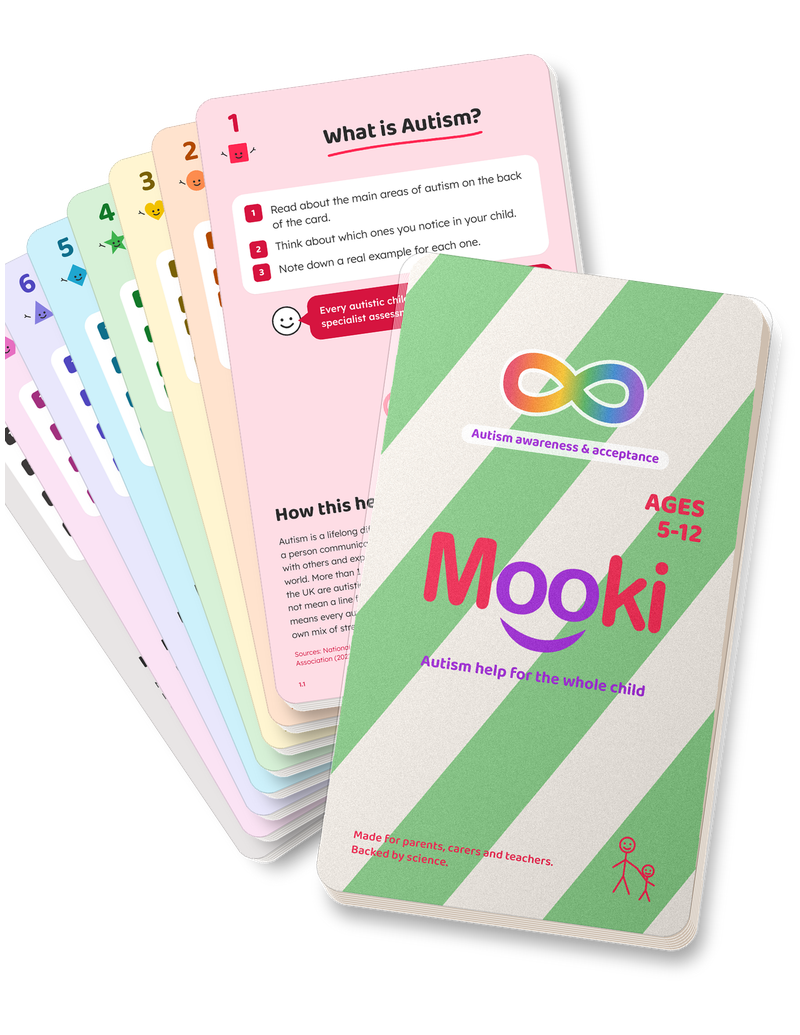
When your child reaches school age, Mooki's Spot the Signs, Getting Assessed and Now and Next cards help you understand and support them. Each is one of 56 ten-minute activities in the Autism deck.
Instant download · use on a phone or tablet, or print and fill in at home or school
A quick month-by-month table
| Age | What most babies do | Possible signs to note |
|---|---|---|
| 9 months | Turn to their name, show feelings on their face | Not responding to name, few facial expressions |
| 12 months | Wave, play pat-a-cake | Few or no gestures, no simple games |
| 15 months | Show you toys to share | Not sharing interests |
| 18 months | Point to show you things | Not pointing to share |
| 24 months | Notice when someone is upset, use more words | Not noticing others’ feelings, loss of words or skills |
This table is a guide, not a test. Many children who miss one item are not autistic.
10 signs of autism in babies and toddlers to discuss with a professional
- Not responding to their name by around 9 months
- Few smiles or facial expressions
- Little babbling or back-and-forth sounds
- Few gestures, such as waving, by 12 months
- Not sharing interests or showing you things
- Not pointing to share by 18 months
- Rarely looking where you point
- Unusual or very strong reactions to sounds, lights or textures
- Repeated movements or very fixed ways of playing
- Losing words or skills they used to have
When to talk to someone: UK and US
Trust your instincts. You know your child best, and asking early is never a waste of anyone’s time.
In the UK
Talk to your health visitor or GP. The NHS offers health and development reviews at 9 to 12 months and at 2 to 2 and a half years, where language, play and social skills are discussed. You don’t have to wait for a review if you are worried. The NHS autism signs page explains the referral route.
In the US
Talk to your pediatrician. The AAP recommends autism screening for all children at the 18 and 24 month well-child visits, and at any time a parent raises a concern. The free CDC milestone checklists help you track development and take notes to your appointment. If your child is under three, you can also contact your state’s early intervention program yourself.
Try it today: a 10-minute connection game
This playful game builds shared attention, whatever is going on for your child.
- Sit face to face on the floor, at your baby’s eye level.
- Choose one simple toy, like a ball or a scarf.
- Hide the toy under the scarf and say “Where’s it gone?” with a big, slow face.
- Pause and wait. Watch if your child looks at you, the scarf, or both.
- Lift the scarf: “There it is!” Smile and copy any sound they make.
- Repeat a few times, then stop while it’s still fun.
Make a quick note of what you saw. These notes are useful if you speak to a professional later.
The bottom line
Every child develops in their own way, and a single late skill is rarely a concern on its own. If you notice several signs, or any loss of skills, talk to your health visitor, GP or pediatrician. Early support is helpful, gentle and focused on your child’s strengths. Asking a question is a caring step, not an overreaction.