Play this fun word-matching game to help dyslexic kids learn to read.
This game breaks words into letters and sounds. These sounds are called phonemes.
A child learns to read by first mastering phonics. Then, they blend these sounds to form whole words.
Blending sounds is based on scientific research: “Persistence of dyslexic’s phonological awareness deficits”.
Free 10-minute course
Help a dyslexic child learn word sounds
Fun sound puzzles, in 3 short activities. 10 minutes a day, with free printable worksheets.
Try it today: blend 3 sounds
A word-matching game makes practising blending sounds fun. Try this quick version:
- Say the sounds – say a short word slowly, one sound at a time: “c – a – t”.
- Blend them – ask your child to push the sounds together to say the whole word: “cat”.
- Match it – ask them to draw or point to a picture of the word.
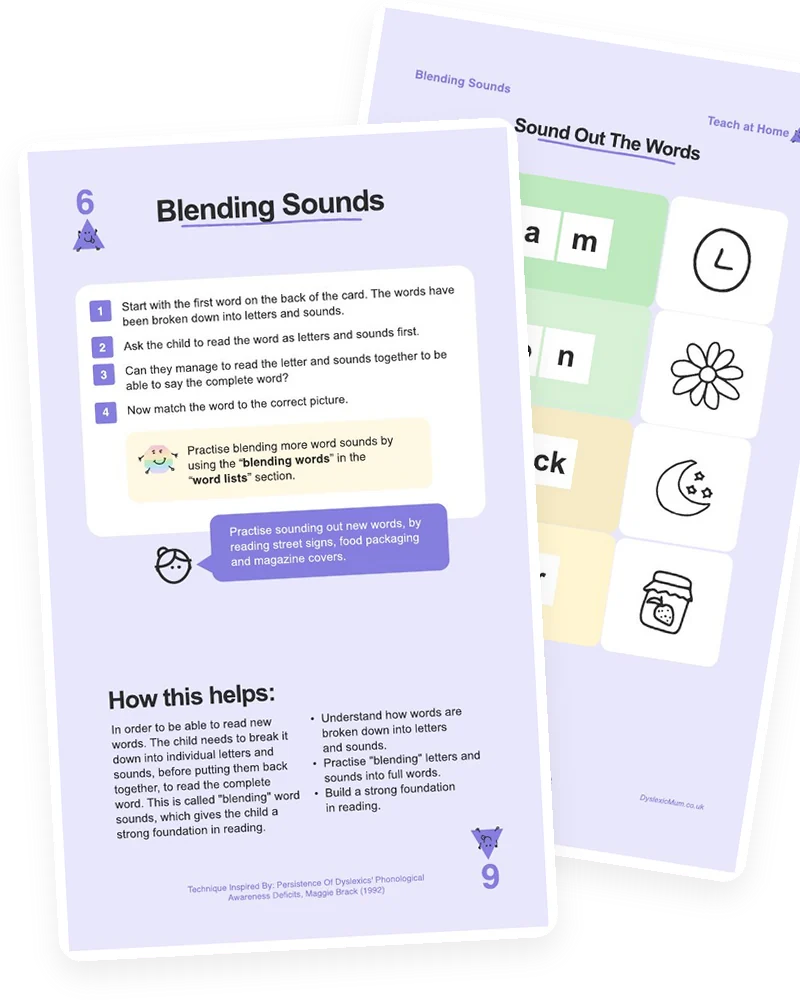
Want the full word-matching game?
The Blending Sounds card has ready-made steps for you on the front and a picture matching game for your child on the back. Everything is in one place. It’s one of 56 ten-minute activities in the Mooki Cards deck.
Instant download · use on a phone or tablet, or print and fill in
Blend word sounds to improve reading
Get help and advice from the Dyslexic Mum below. She shares how she helped her child learn to read better.
“Starting school means starting to do homework. My child was given a reading folder and brought home a reading book every week. We did my child’s reading homework in the evening, after dinner, when she was not too tired.
We started by reading just the letters in words from the books. Then we built up to reading letters together as sounds, such as the ‘ch’ at the start of ‘chicken’. Then we blended all the sounds and letters to say full words.”
Watch the video ‘Blending Sounds’ below. The Dyslexic Mum shows how to play the game.
When you play a blending sounds game to help a dyslexic child learn word sounds, follow these top tips:
- Play again – you can play this game again and again. Check the “200 words list” for extra words to practise.
- Match pictures – when practising extra words, match them to pictures. This helps the child remember letters and spellings.
- Have fun learning – the Mooki Cards offer many fun games to help children improve their reading skills.
See the “Teach dyslexic child reading guide” for more activities to practise word sounds.