
Most children can write their first name by about age 5, around the start of kindergarten or reception year. Some learn earlier, and children with dyslexia may take a little longer. Here is what’s typical by age, when to look more closely, and fun ways to help your child learn.
Every child develops at their own pace. Here is a rough guide to how spelling skills grow in young children:
- 3–4 years old: starts to recognize and name some letters, often the ones in their own name
- 4–5 years old: begins to hear the sounds in words and may write their name, with some letters back to front
- 5–6 years old: writes their name and spells some simple words and common sight words
- 6–7 years old: spells more words on their own, using sounds to have a go at new ones
Don’t worry if your child mixes up letters or writes some back to front at this age. That is a normal part of learning.
At what age should a dyslexic child be able to spell their name?
Children with dyslexia often find it hard to link letters with their sounds. The British Dyslexia Association explains that this difficulty with the sounds in words is the most common sign of dyslexia.
This can make it harder for a dyslexic child to learn to spell their name, so they may get there later than other children. There is no set age. What matters is steady progress with the right help.
It may be worth talking to your child’s teacher if your child:
- still can’t write their name after lots of practice in their first year of school
- writes the letters of their name in a different order each time
- struggles to recognize the letters in their name
- also finds rhymes, letter names or following instructions hard
These can be early signs of dyslexia. Read more about the signs of dyslexia in 5 to 10 year olds.
Try it today: learn to spell their name in 10 minutes
- Say and point (2 minutes). Write your child’s name in big letters. Say each letter as you point to it, then say the sounds.
- Trace it (2 minutes). Ask your child to trace over the letters with their finger, then with a crayon.
- Make it messy (3 minutes). Write the name in sand, shaving foam or with paint. Using touch helps the letters stick.
- Build it (2 minutes). Mix up letter tiles or cut-up letters and ask your child to put their name back in order.
- Spot it (1 minute). Hunt for the letters of their name on signs, food packets and books.
Practise little and often, a few minutes a day, and praise every try.
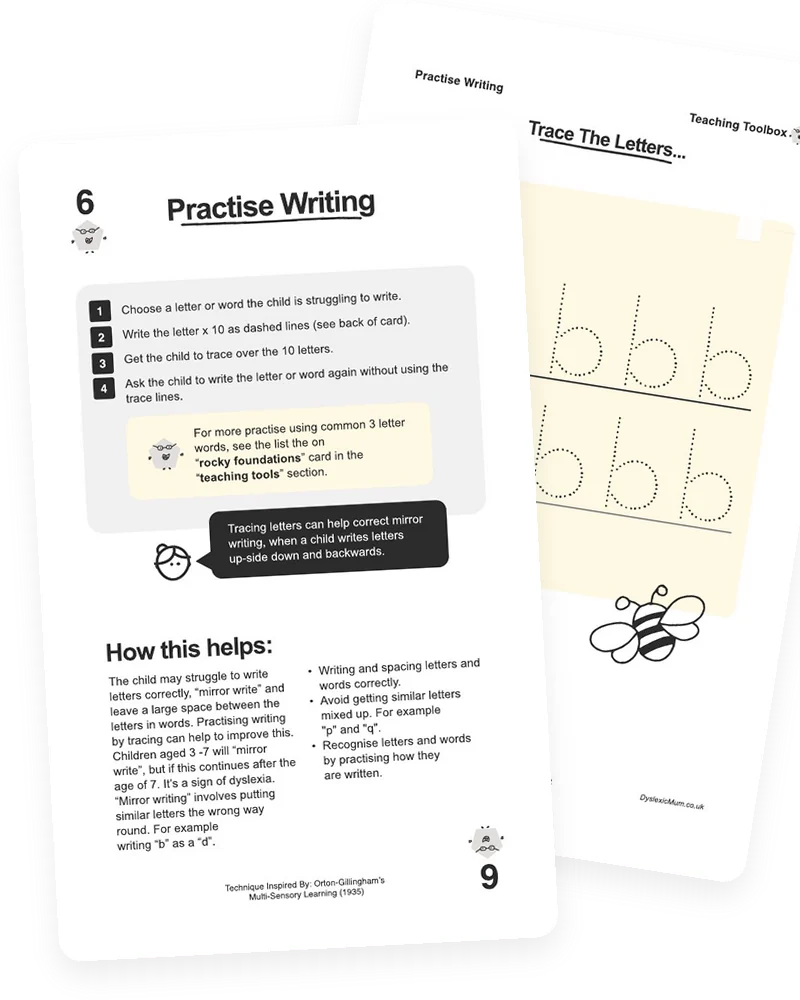
Want ready-made writing practice?
The Practise Writing card turns writing practice into a fun 10-minute game, with steps for you on the front and an activity for your child on the back. Pair it with the Muscle Memory card to help spellings stick. Both are among 56 ten-minute activities in the Mooki Cards deck.
Instant download · use on a phone or tablet, or print and fill in
Help a dyslexic child improve their spelling
Once your child can spell their name, try these 10-minute activities to build their spelling skills:
- Multi-sensory learning
- Build strong foundations in reading, writing and spelling
- Goal ladder: help a dyslexic child focus
- Rule of 10
- Tricky words to spell
- High frequency words
- Memory tags: remember spellings using rhymes
- Muscle memory
The British Dyslexia Association’s spelling advice has more ideas.
Could it be something more?
Lots of young children find spelling their name tricky. That is normal. But if your child is also late to talk, or finds it hard to understand what you say, they may have a speech, language and communication need. If they find it hard to sit still and focus long enough to practise, read about the 3 types of ADHD. You can also check the NHS guide to dyslexia symptoms.
The bottom line
Most children can write their name by about age 5, but every child is different, and dyslexic children may need more time and practice. Keep it short, fun and multi-sensory. For ready-made activities, the Mooki Cards deck has 56 ten-minute cards, including Practise Writing and Muscle Memory, to help your child learn to spell their name and much more.