
If you have just heard the word dyscalculia from a teacher, a friend or a late-night search, this guide is for you. In plain English, you’ll find out what dyscalculia means, how to say it, how common it is and what it can look like in a primary school child.
Dyscalculia is a real and quite common learning difference. It is not a sign that a child is lazy, slow or “just not a maths person”. With the right understanding and steady, kind practice, children with dyscalculia can grow in confidence with numbers.
What is dyscalculia? The meaning in plain English
Dyscalculia is a specific learning difficulty that makes it hard to understand numbers and how they work. The British Dyslexia Association uses a definition from SASC, the group that sets standards for assessors. It says the most common core difficulty is a persistent problem understanding the size of numbers.
That might sound small, but it matters a lot. If you can’t easily “feel” that 8 is bigger than 3, or that 7 is close to 10, then adding, taking away, place value, money and time all become much harder.
A few key points about the dyscalculia meaning:
- It is lifelong, although how it shows up can change as a child grows.
- It is not caused by low intelligence, poor teaching or laziness, as Understood explains.
- It can happen alongside other differences, such as dyslexia, ADHD, developmental language disorder (DLD) or dyspraxia (DCD).
- Every child is different. Some children find only basic calculation hard. Others find many areas of maths tricky.
You may also see it spelled “dyscalulia” or “dyscalcula” online. The correct spelling is dyscalculia.
How do you pronounce dyscalculia?
Say it like this: dis-kal-KYOO-lee-uh. The stress falls on the “KYOO” part.
The word comes from Greek and Latin. “Dys” means badly or with difficulty, and “calculia” comes from the word “calculate”, which has Latin roots. Dictionary.com gives both the UK and US pronunciation, which are almost the same.
If your child asks about the word, you could say: “It’s a long name for when your brain finds numbers a bit trickier to learn. Lots of people have it, and there are good ways to help.”
How common is dyscalculia?
Dyscalculia is much more common than most people think. It is just talked about far less than dyslexia.
- A large study of over 2,400 primary school children in Northern Ireland found that about 6 in every 100 children had severe, persistent maths difficulties. After other explanations were ruled out, just under 6 in 100 (5.7%) fitted the profile of dyscalculia.
- The British Dyslexia Association gives a similar figure of about 6% of people, and says around a quarter of people have wider maths learning difficulties.
In a class of 30, that could mean one or two children with dyscalculia. The same study found that boys and girls were affected about equally.
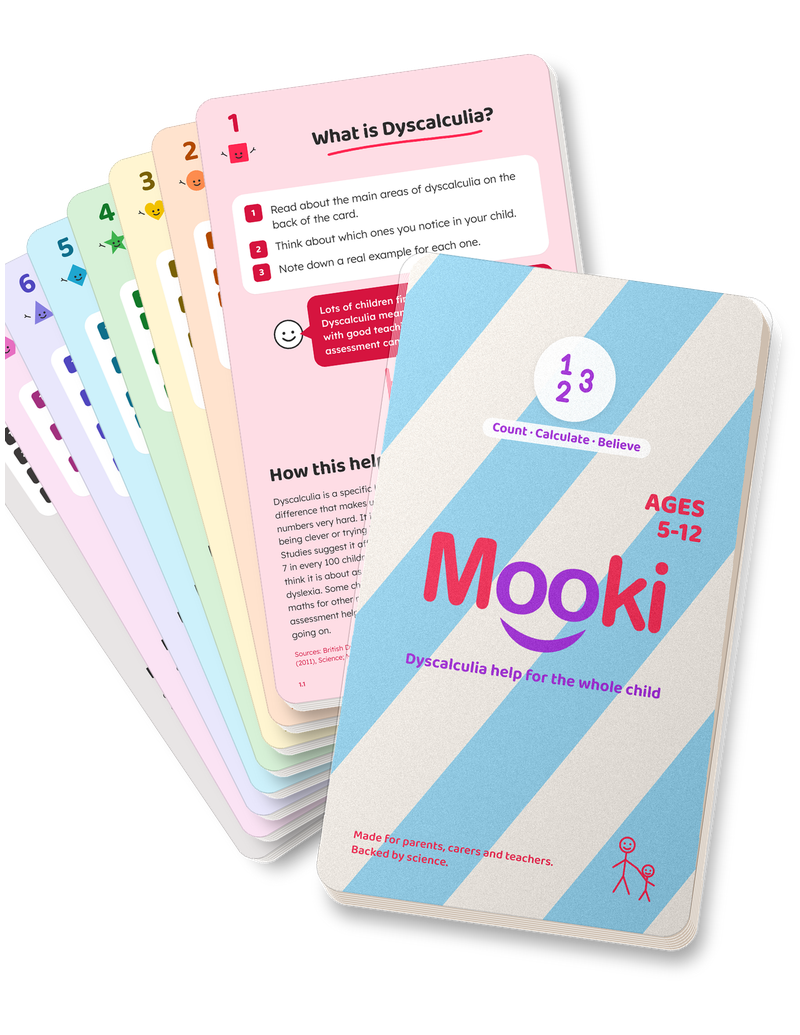
Want to build your child's number confidence?
Start with What is Dyscalculia? to explain it simply, then try Quick Look and How I See Numbers to build number sense. Each is one of 56 ten-minute activities in the Mooki Cards dyscalculia deck.
Instant download · use on a phone or tablet, or print and fill in at home or school
What does dyscalculia look like in primary-age children?
Signs vary with age, and one sign on its own doesn’t mean a child has dyscalculia. What matters is a pattern of difficulty that carries on, even with good teaching and plenty of practice.
In Reception and Year 1 (pre-K and kindergarten in the US)
- Finds it hard to learn the counting words in order.
- Counts objects but can’t say “how many” at the end.
- Struggles to match the numeral 5 to a group of five things.
- Can’t tell which of two groups has more without counting both.
In Years 2 to 6 (grades 1 to 5 in the US)
- Still counts on fingers for simple sums long after classmates have stopped.
- Finds it very hard to remember number facts, like 4 + 5 or 3 x 2.
- Mixes up place value, such as writing 52 for “twenty-five”.
- Finds money, time and measuring confusing.
- Gets anxious or upset when maths comes up, or avoids number games.
Understood’s guide to signs at different ages has more examples if you want to compare.
What dyscalculia is not
There are a few common myths worth clearing up:
- It is not about being clever. Many children with dyscalculia are bright, creative and very capable in other subjects.
- It is not just maths anxiety. Worry about maths can make things harder, and the two often go together, but anxiety on its own is not dyscalculia.
- It is not something a child will simply grow out of. With good support, though, children can learn strategies that make a real difference.
- It is not a parent’s fault. Nothing you did or didn’t do caused it.
Is there a dyscalculia symbol?
People sometimes search for a dyscalculia symbol or logo. There isn’t one official, agreed symbol. Different charities and awareness groups use their own designs.
What matters more than a symbol is the word itself. Once your child’s school and family share the same language, it becomes much easier to talk about support.
Getting help in the UK and the US
If you’re worried, start with your child’s class teacher. They see your child’s maths every day and can tell you what they notice.
In the UK, the next step is usually the school’s SENCo (special educational needs co-ordinator). Schools can put SEN support in place without a formal diagnosis. A formal dyscalculia assessment is done by a specialist teacher or educational psychologist, not usually through the NHS.
In the US, talk to your child’s teacher and ask about an evaluation. Public schools can evaluate children for free under the special education law IDEA. Support may then come through an IEP or a 504 plan.
Try it today: a 10-minute number confidence game
Here’s a simple, calm activity you can do this evening. You’ll need a handful of small objects, like dried pasta, buttons or Lego bricks.
- Put out a small group of 2 to 5 objects, then cover them with your hand or a cup.
- Lift the cover for two seconds and ask: “How many did you see?”
- Count them together to check. Praise the thinking, not just the answer: “You spotted them really quickly.”
- Try making the same number in a different pattern, such as a line, a triangle or a dice shape.
- Stop after ten minutes, while it’s still fun.
Seeing small amounts at a glance without counting is called subitising. It’s one of the building blocks of number sense, and the Education Endowment Foundation recommends weaving maths into play and everyday activities for young children.
How short daily activities build number confidence
Children with dyscalculia often need more practice than their classmates, and they need it to feel safe. Long, stressful homework battles rarely help. Short, regular and playful sessions usually work better.
A good routine looks like this:
- Little and often: ten minutes a day beats an hour on Sunday.
- Hands on: use real objects, then pictures, before moving to written numbers.
- Talk about it: ask “How did you work that out?” rather than just “What’s the answer?”
- Celebrate effort: notice progress, however small.
This is exactly why Mooki Cards are built around ten-minute activities. Each one gives you simple steps on the front and a game or worksheet for your child on the back.
The bottom line
Dyscalculia is a common, lifelong difference in how the brain handles numbers. It has nothing to do with how clever or hard-working your child is. If you spot signs that worry you, talk to your child’s teacher or SENCo, and keep maths at home calm, short and playful. Small, steady steps really do add up.