Help a dyslexic child write essays and stories by using a Thought Tree to organise their ideas.
A Thought Tree is a type of mind map. It helps dyslexic children to get their thoughts down on paper quickly, by using:
- Keywords.
- Pictures.
It is perfect for planning larger pieces of work, such as:
- Projects.
- Presentations.
- Essays.
- Stories.
Free 10-minute course
Help a dyslexic child learn new spellings
Read, write and remember new words, in 3 short activities. 10 minutes a day, with free printable worksheets.
Why do dyslexic kids struggle to write ideas?
Dyslexic children often have many ideas but struggle to express them.
They tend to think in pictures and often have difficulty with spelling. This can make it harder for them to start writing and to put their ideas into words.
Mind-mapping helps dyslexic children take notes and organise their ideas by:
- Writing down ideas in any order.
- Adding basic keywords.
- Using colours and patterns.
- Drawing pictures.
The Thought Tree is based on scientific research into mind maps. To learn more, visit: Inventor of mind maps, Tony Buzan.
Try it today: a quick Thought Tree
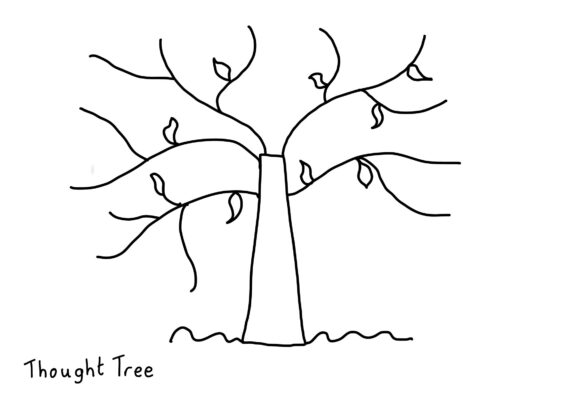
Choose a topic your child needs to write about, for example my holiday. Then:
- Draw a tree trunk – write the topic on the trunk.
- Add branches – your child adds one idea to each branch. They can use a word, a drawing or a sticker.
Ideas can go on in any order. Spelling does not matter yet. The aim is to get the ideas out of their head and onto the paper.
Print the free Thought Tree worksheet: write the topic on the trunk and one idea on each branch.

Want a Thought Tree your child can follow on their own?
The Thought Tree card has ready-made steps for you on the front and a picture activity for your child on the back, showing how their tree grows step by step. Everything is in one place. It’s one of 56 ten-minute activities in the Mooki Cards deck.
Instant download · use on a phone or tablet, or print and fill in
How to make a Thought Tree mind-map
Check out advice from the Dyslexic Mum. She shares her top tips for making a Thought Tree.
A parent’s story
“When I went to school in the 1980s, they still had blackboards. In lessons, we copied information from the board. No talking was allowed.
After that, we got a list of questions or were told to write an essay. I remember staring at the blank white paper, my head spinning. I had so many ideas, but I couldn’t write them down. When I tried, it came out jumbled, and then I’d get in trouble for not trying or being lazy. It was tough. What I needed was a way to get my ideas on paper quickly before writing a longer piece. Mind maps are great for this, but sadly I didn’t discover them until after I’d left school. Now I use them with my child, who has SEN. With just simple words and pictures, my child can get their ideas onto paper, and then we talk about them before answering the homework questions.”
In the video below, Thought Tree, the Dyslexic Mum shows how to create a mind map.
Follow these top tips when using a Thought Tree:
- If a dyslexic child finds it hard to write a lot, suggest the Thought Tree.
- They can draw a tree and add ideas to the branches. Use words, drawings, or stickers.
- The child can hold it up and discuss their ideas. You can help by writing down what they say.
- The Thought Tree can also be used in class. It helps a dyslexic child take notes quickly.