
Help a dyslexic child to show that they need help by giving them the tools to communicate better.
Dyslexic children have trouble processing and understanding information. If they struggle with classwork, they may feel:
- Stressed.
- Anxious.
- Frustrated.
These feelings often result in:
- Hyperactivity.
- Unfocused behaviour.
- Lack of motivation.
To support dyslexic children in class, use dyslexia-friendly teaching methods. This might involve the teacher re-explaining tasks with the child and teaching strategies like multi-sensory learning.
Free 10-minute course
Help a dyslexic child follow instructions
Check they’ve understood and help them ask for help, in 3 short activities. 10 minutes a day, with free printable worksheets.
The traffic light system
A traffic light system is a simple way for a dyslexic child to show if they need help.
It is based on scientific research. Learn more: “Assistive systems for children with dyslexia”.
Try it today: a simple traffic light
- Make it – draw a red, an amber and a green circle on a piece of paper.
- Agree what it means – for example, green means “I understand” and red means “I need help”.
- Use it – keep it on the child’s desk. When they point to red, go over the task with them.
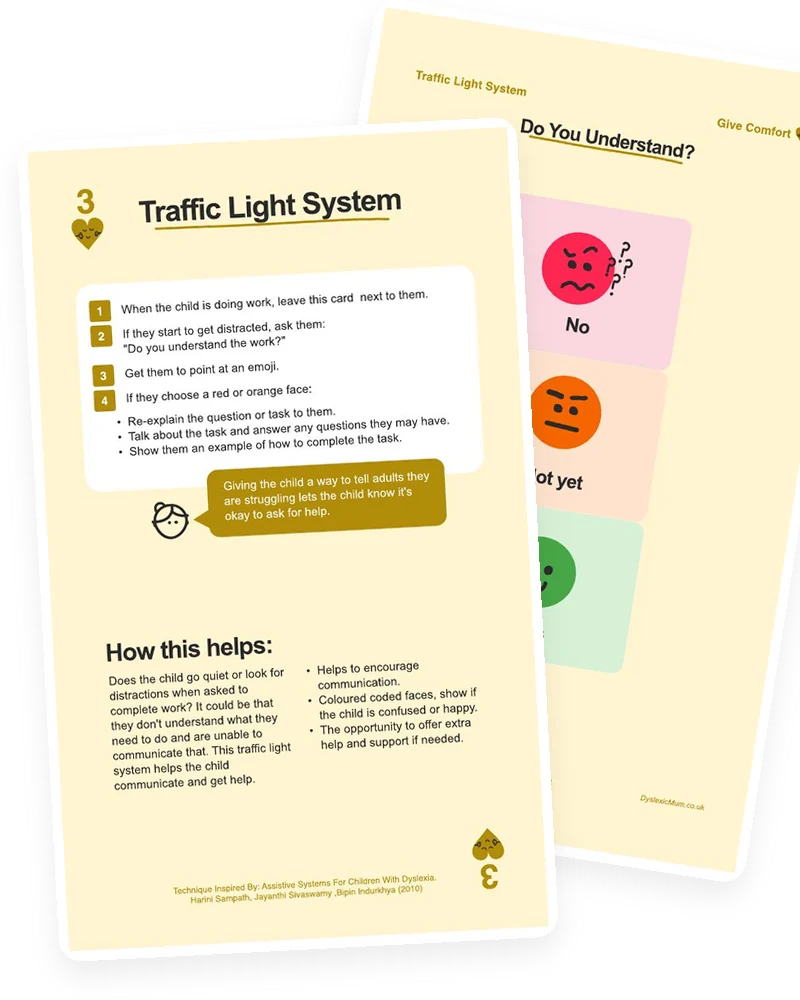
Want a ready-made traffic light your child can use?
The Traffic Light System card has simple steps for you on the front and a picture activity for your child on the back. Everything is in one place. It’s one of 56 ten-minute activities in the Mooki Cards deck.
Instant download · use on a phone or tablet, or print and fill in
How to communicate understanding
Read what the Dyslexic Mum learned about children asking for help:
“Spending most of my career in teaching, I have seen many types of behaviour that show a child does not want to do work. These include talking, staring out the window, shouting, and misbehaving in class. I realised that the root of this behaviour was often not a lack of desire to work. Usually, it stemmed from not knowing how to do the work.
It can be scary, shameful, and even humiliating for a child to admit they do not understand something. Young children may not realise they can ask for help, fearing they will get into trouble. This traffic light card makes it simple for a child to signal when they need help.”
Watch the video below: ‘Help someone with dyslexia to communicate’.
To get the most from a traffic light system, follow these top tips:
- Traffic light feelings – a traffic light helps a child ask for help with schoolwork. They can point to a colour that shows how they feel about their understanding.
- Give help – it is important to know when a child needs support. Without timely help, they might misbehave and lose motivation.
- Avoid punishment – if a child loses focus, do not punish them. Instead, help them understand what to do next. Offer praise and breaks when needed.
To learn more about creating a dyslexia-friendly learning environment see Calm Corner.