Help a dyslexic child to learn facts and spell new words.
The dyslexic brain can struggle to:
- Process information.
- Remember facts.
- Recall sequences.
The dyslexic brain thinks best in:
- Pictures
- Stories
- Rhymes
If you link a picture or rhyme to a list of facts, a dyslexic child is more likely to remember them. For example, when teaching the months of the year, show pictures of snow and sunshine to help their memory.
This idea is based on research. Learn more: Dyslexics have better picture memory.
Free 10-minute course
Help a dyslexic child learn new spellings
Read, write and remember new words, in 3 short activities. 10 minutes a day, with free printable worksheets.
Try it today: make a Memory Tag
A Memory Tag is a silly sentence or rhyme. Each word starts with the next letter of the spelling. It turns a tricky spelling into a picture in the child’s head.
- Learn one together – for the word the, try “two heavy elephants”. Say it, then picture the elephants.
- Make your own – pick one word your child is learning. Ask them to make up a funny sentence for it, one word for each letter.
The sillier the sentence, the easier it is to remember. Ask your child to draw a picture of it, too.
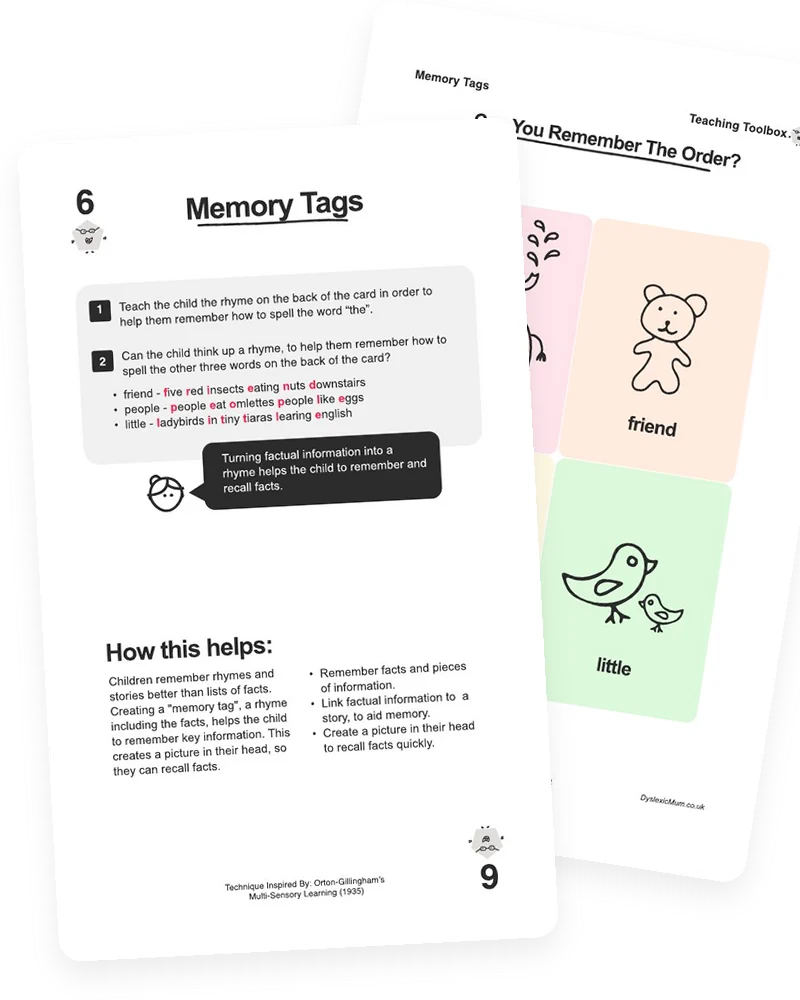
Want more ready-made Memory Tags?
The Memory Tags card has ready-made steps for you on the front, with more tricky words and rhyme ideas to get you started. Your child gets a picture activity on the back. Everything is in one place. It’s one of 56 ten-minute activities in the Mooki Cards deck.
Instant download · use on a phone or tablet, or print and fill in
Memory and sequencing dyslexia
To help a dyslexic child learn new spellings and remember facts, try these top tips:
- Dyslexic children learn best with pictures, rhymes, and stories: Use photos, videos, and songs to help them remember facts and spellings.
- If a child enjoys learning, they remember better: So, help them have fun. Try singing the Memory Tag rhyme you made together.
- When learning a new spelling, focus on one word at a time: Wait until the child feels confident spelling it. Then give plenty of praise when they get it right.
- Next, try the Rule of 10 and Multi-sensory Learning: These methods help dyslexic children learn to read, write, and spell in a dyslexia-friendly way.
A parent’s story
One SEN parent noticed the power of rhyme early on:
“When my child started school, they came home singing the Alphabet Song. It’s one of the first things children learn: all 26 letters in the right order. It seems like a simple rhyme, but for a four-year-old to remember every letter in order is quite amazing.
The reason it sticks is that it’s a song. Children find it much easier to remember the words to a song than a list of information. Now we use rhymes to remember everything, from lists of facts to new spellings.”
Watch the video below, ‘How to help a child with spelling difficulties’.