
Learn how to get dyslexia help for a child by communicating with teachers effectively.
Being able to communicate what you need and to get the right help is a skill.
Non-violent communication helps everyone feel heard and find the best solution together.
This can be done by:
- being clear
- sticking to the facts
- talking about your feelings
- showing empathy
- listening to the other person
- working together
- coming to a joint solution
This approach is based on scientific research, on ‘Non violent communication’.
Free 10-minute course
Spot the signs of dyslexia
Know what to look for and what to do next, in 3 short activities. 10 minutes a day, with free printable worksheets.
Talk so teachers listen
Get advice from the Dyslexic Mum on how she learned to speak to teachers more effectively:
“I used to find it so stressful speaking to my child’s teachers about her dyslexia. I would try to grab them during school drop-off for a quick chat. Children and other parents would surround the teachers, all wanting their attention too. It was chaotic!
When I finally got a chance to speak to the teachers, I would get myself in a muddle, and I did not get the dyslexia help my little girl needed. I realised that maybe it was the way I was asking for help, that I needed to be clearer about what help we needed and why my little girl needed it.”
Watch the clickable video below, ‘Get dyslexia help from school’.
When talking to teachers about dyslexia, use these top tips:
- Stick to Facts: When talking to the child’s teacher about dyslexia, stick to the facts. Have 3 examples of why you think the child is dyslexic. Read “Signs of dyslexia in 5 to 10 year olds” and “Spot dyslexic writing” to help you.
- Organise a Meeting: Speak to the child’s teacher when it is quiet and you won’t be interrupted. Ask to organise a meeting, and request that people who can help attend, such as the Special Educational Needs Co-ordinator.
- Say What You Need: When you ask for help, teachers can use lots of educational jargon. You can go away feeling more confused, without the extra help you need. To keep it simple, ask for a “Learning Plan” to be written for the child.
- Learning Plan: A child does not need to have been formally assessed as being dyslexic to be given a learning plan. This can be given to any child who is struggling. It shows clear goals that they will work towards, to help them catch up.
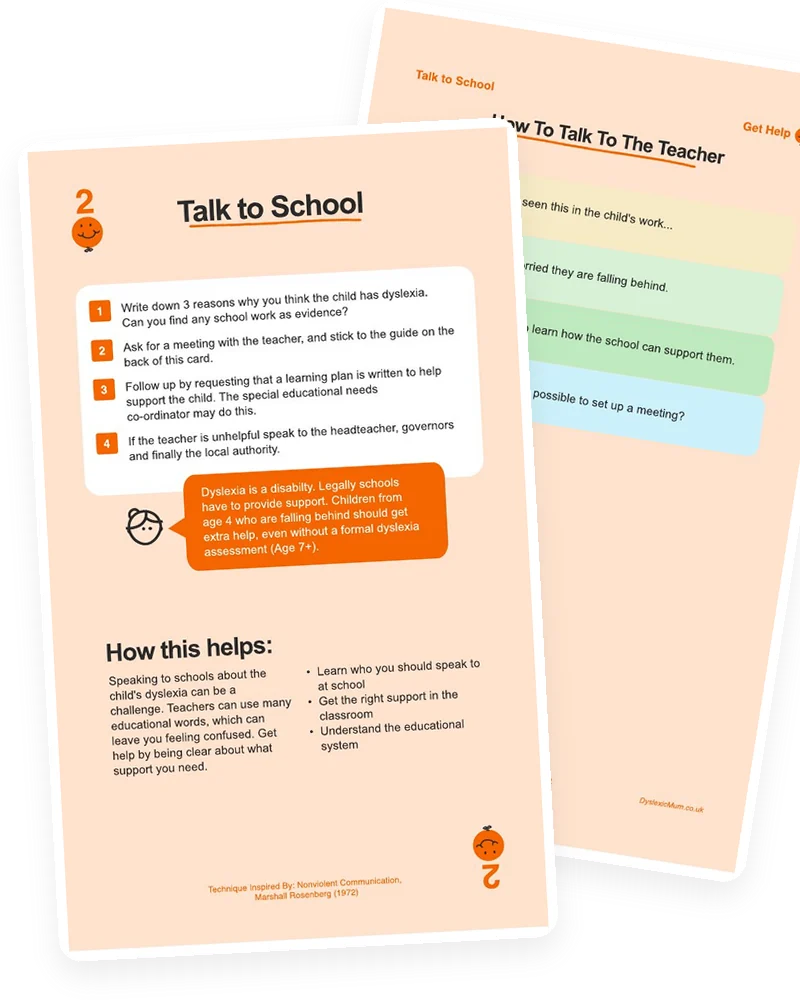
Want a simple plan for your next school meeting?
The Talk to School card has ready-made steps for you on the front and a picture activity for your child on the back, so everything you need is in one place. It’s one of 56 ten-minute activities in the Mooki Cards deck.
Instant download · use on a phone or tablet, or print and fill in