
This autism checklist for parents helps you note what you see at ages 1 to 5, from the 12 month stage to a 4 year old autism checklist, so you can have a clear, calm conversation with a professional.
Before we start, one important point. This is an observation checklist, not an autism test. No online quiz can diagnose autism. What a checklist can do is help you organise your thoughts, spot patterns and take useful notes to an appointment.
Checklist vs screening vs diagnosis
These three words are often mixed up. Here’s the difference.
- Observation checklist: notes you make at home about what your child does. Anyone can use one.
- Screening: a short, structured questionnaire used by a health professional to see if a child needs a closer look. It does not diagnose.
- Diagnosis: a full assessment by a specialist team, using observation, interviews and reports.
The CDC explains that a screen does not diagnose autism. It only shows whether a child is on track or needs more checks.
18 month autism screening and the 2 year old autism test
What is the M-CHAT?
The most common screening tool in US pediatric offices is the M-CHAT-R/F. It is a 23-item questionnaire filled in by parents. It asks about things like pointing, eye contact and pretend play.
According to HealthyChildren.org, the American Academy of Pediatrics recommends autism screening for every child at the 18 and 24 month checkups. A positive screen does not mean your child is autistic. It means the doctor will ask more questions or refer for testing. A negative screen doesn’t catch every child either, so keep speaking up if you are still worried.
The UK route
In the UK there is no national autism screening programme for all toddlers. Instead, your health visitor offers development reviews at 9 to 12 months and 2 to 2 and a half years. Parents fill in a questionnaire called the ASQ-3 beforehand, which covers speech, play and social skills. If there are concerns, your health visitor or GP can refer your child to a local team.
The autism checklist by age
Work through the age that matches your child, and the one before. Tick what you see often, not just once. Write a short example next to anything that stands out. Many of these signs come from the CDC’s list of autism signs.
12 month old autism checklist
- Rarely turns when you say their name
- Few facial expressions or shared smiles
- Doesn’t play simple games like pat-a-cake or peekaboo
- Uses few or no gestures, such as waving
- Rarely looks where you point
18 months to 2 years
- Doesn’t point to show you things just to share
- Doesn’t bring toys to show you
- Few words, or words used to name things but not to ask
- Doesn’t notice when someone is hurt or upset
- Lines up toys or plays with them the same way each time
- Has lost words or skills they used to have
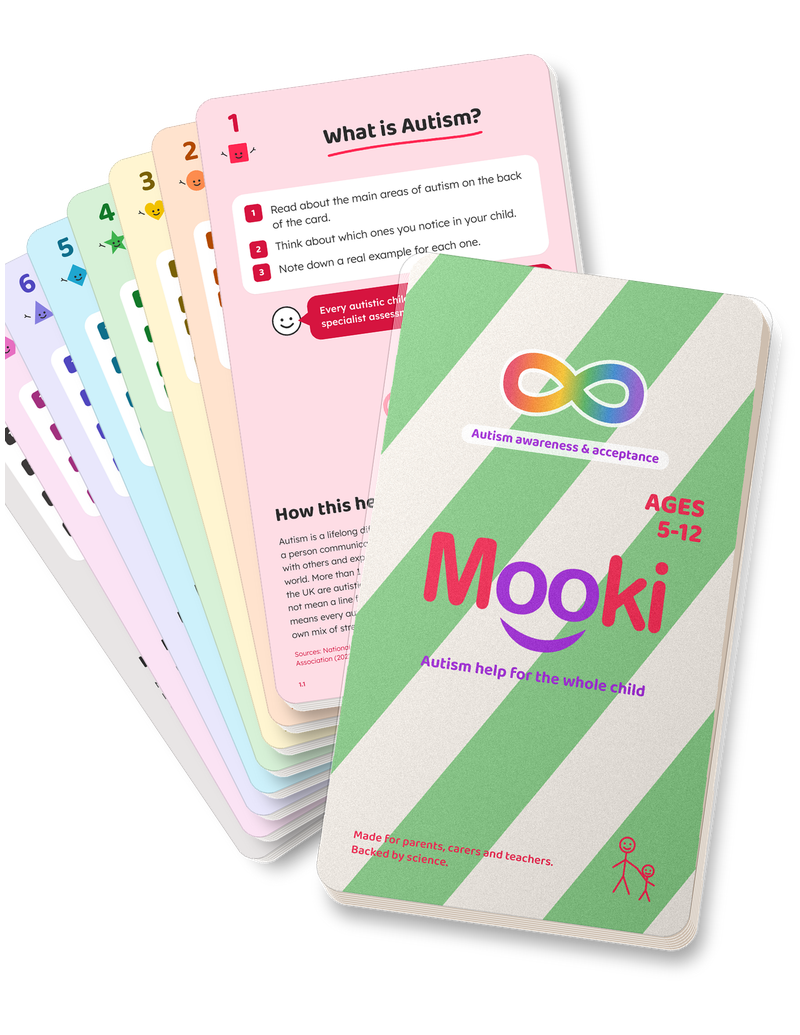
Want a simple way to record what you notice?
Mooki's Spot the Signs, Behaviour Detective and Getting Assessed cards help you note patterns and prepare for appointments. Each is one of 56 ten-minute activities in the Autism deck, with a printable sheet.
Instant download · use on a phone or tablet, or print and fill in at home or school
3 year old autism checklist
- Doesn’t notice other children or join them in play
- Little pretend play, like feeding a teddy
- Repeats words or phrases, sometimes from TV
- Gets very upset by small changes to routine
- Has very strong reactions to noise, clothing labels or food textures
- Uses repeated movements, like hand flapping or spinning
4 year old autism checklist
- Doesn’t pretend to be someone else in play, like a superhero or teacher
- Finds it hard to take turns in a conversation
- Talks a lot about one topic without noticing if you are interested
- Takes words very literally
- Struggles with group times at nursery or preschool
- Needs things done in a set way and becomes distressed if not
5 years
- Doesn’t sing, dance or act for you, or show off a new skill
- Finds it hard to make or keep friends
- Is upset by changes, even small ones
- Seems “fine” at nursery or school but has big reactions at home
That last one is common. Many children hold it together all day, then let it out somewhere they feel safe.
How to use your checklist
A list on its own is easy to dismiss. A list with examples is powerful.
- Write real examples. “Didn’t turn when I called her name three times at the park” says more than “doesn’t respond to name”.
- Note strengths too. What does your child love? What are they good at? This helps professionals see the whole child.
- Ask others. Your child’s nursery, childminder or grandparents may notice different things.
- Date your notes. Patterns over weeks are more useful than one hard day.
- Take it with you. Bring the sheet to your appointment and hand over a copy.
Try it today: a 10-minute observation
Choose a calm time and simply watch your child play. Don’t direct the play.
- Sit nearby with a cup of tea and a notepad.
- Notice: Does your child look at you? Do they bring you anything? How do they use their toys?
- After five minutes, call their name once in a normal voice. Note what happens.
- Join in by copying what they do. Notice if they look up or include you.
- Write three quick notes: one thing that surprised you, one strength, and one question.
What to do next in the UK and US
In the UK
Speak to your health visitor if your child is under five, or your GP. If your child goes to nursery, the setting’s SENCo can share what they see and put support in place. The NHS autism assessments page explains how referral works.
In the US
Ask your pediatrician for a developmental and autism screen, even outside the usual 18 and 24 month visits. If your child is under three, you can contact your state’s early intervention program directly. The CDC confirms you don’t need a doctor’s referral. From three, your local school district can carry out an evaluation for free.
If you’re worried, talk to your GP or paediatrician, or your child’s school.
The bottom line
A checklist helps you put your worries into words. It does not diagnose, but it makes your voice stronger in every appointment. Note what you see, include your child’s strengths, and ask for help early. Whatever the outcome, you’ll understand your child a little better.