
This guide walks you through dyscalculia symptoms at each stage of primary school, from Reception to Year 6 (kindergarten to 5th grade in the US). You’ll see what to look out for at each age and get simple ideas to try at home.
Every child learns maths at their own pace, and the odd wobble is normal. Dyscalculia signs are different: they are persistent, they don’t shift much with extra practice, and they often show up in everyday life as well as in maths lessons.
What are the main dyscalculia symptoms?
At its heart, dyscalculia makes it hard to understand number size and how numbers relate to each other. The SASC definition shared by the British Dyslexia Association describes difficulty with naming, ordering and comparing quantities and numbers, estimating and understanding place value.
Across all ages, common dyscalculia signs include:
- Relying on counting in ones for a long time.
- Finding number facts very hard to remember.
- Confusion about which number is bigger or smaller.
- Trouble with money, time and measuring.
- Worry or avoidance around anything with numbers.
Remember: one sign alone doesn’t mean dyscalculia. Look for a pattern that lasts.
Dyscalculia signs at a glance
UK school years and their rough US equivalents are shown below.
| Stage | What is typical | Possible dyscalculia signs |
|---|---|---|
| Reception (age 4 to 5, pre-K/kindergarten) | Counts small groups, knows “how many” after counting | Can’t say how many after counting, struggles to link 3 to three things |
| Years 1 and 2 (kindergarten to grade 1) | Becoming fluent with adding and taking away within 10 | Still counts every sum from one, number bonds won’t “stick” |
| Years 3 and 4 (grades 2 and 3) | Using tens and ones, learning times tables | Muddles place value, very slow with facts, avoids times tables |
| Years 5 and 6 (grades 4 and 5) | Working with larger numbers, fractions, money and time | Can’t estimate or check answers, struggles with change and clocks |
Reception (pre-K and kindergarten in the US)
In Reception, children are building early number sense. They learn to count, match numbers to groups, and compare amounts. Understood’s preschool signs are a helpful guide here.
Look out for a child who:
- Can recite numbers but loses track when counting objects.
- Hands you a big pile when you ask for “five blocks”.
- Can’t tell which plate has more biscuits without counting both.
- Struggles to link the written 4 to four things.
- Asks “is it lunch yet?” straight after breakfast, with little sense of time.
Try at home: count stairs as you climb them, set the table (“we need four forks”), and play “who has more?” with grapes or crackers.
Years 1 and 2 (kindergarten to 1st grade in the US)
In England, the Department for Education’s maths guidance expects children in Year 1 to become fluent in adding and taking away within 10, and to secure this in Year 2. That makes this stage a time when difficulties often become clearer.
Signs to look out for:
- Counts on fingers from one every time, even for 2 + 1.
- Can’t “count on” from the bigger number.
- Finds number bonds to 10 (like 7 and 3) very hard to remember.
- Struggles to count backwards or in 2s, 5s or 10s.
- Mixes up + and – or the words “more” and “less”.
- Reverses or mixes up two-digit numbers, such as 12 and 21.
Try at home: play with a ten frame (a grid of 2 rows of 5 boxes) using coins or counters. Ask “how many more to make 10?”
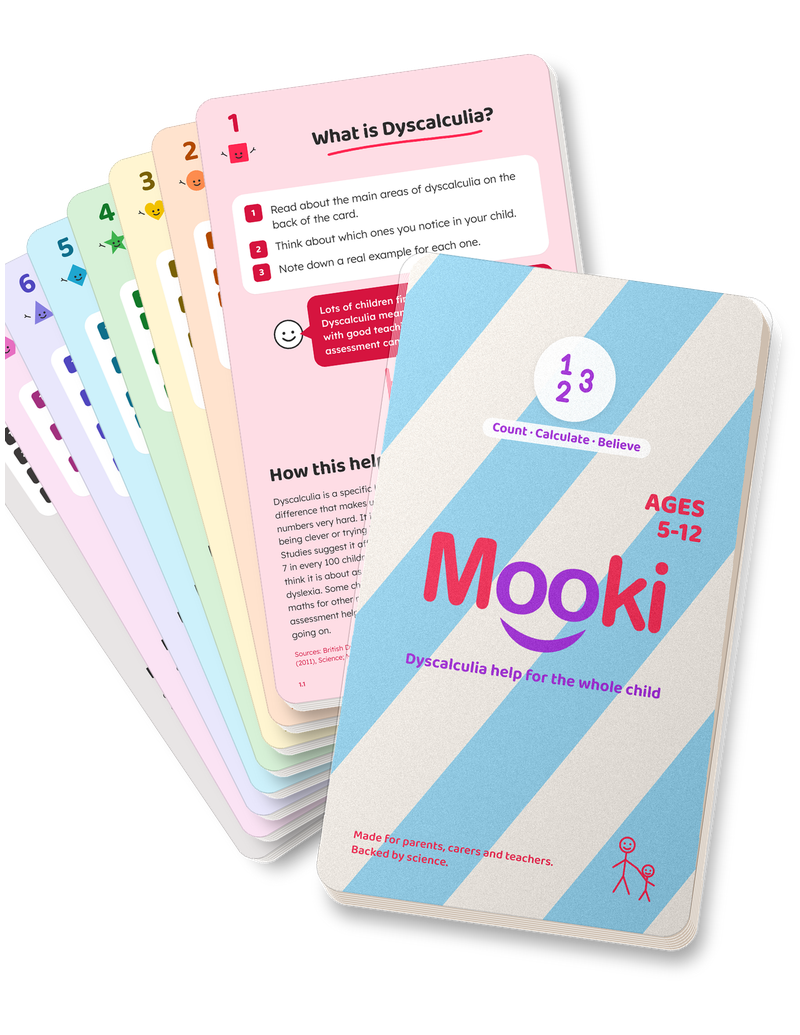
Spotted some signs? Here's where to start
Spot the Signs helps you note what you see, while Number Bonds and Ten Frames build key skills through play. Each is one of 56 ten-minute activities in the Mooki Cards dyscalculia deck.
Instant download · use on a phone or tablet, or print and fill in at home or school
Years 3 and 4 (2nd and 3rd grade in the US)
Now children work with bigger numbers, tens and hundreds, and start learning times tables. In England, Year 4 pupils take the multiplication tables check, which covers tables up to 12 x 12. This can be a stressful time for a child with dyscalculia.
Signs to look out for:
- Doesn’t understand that the 4 in 45 means four tens.
- Writes numbers in the wrong columns.
- Learns a times table, then seems to lose it within days.
- Finds mental maths very slow and tiring.
- Struggles with simple word problems, unsure which operation to use.
- Starts telling the time but finds “quarter to” and “past” confusing.
- Avoids games with scores or dice.
Understood’s grade-school signs also mention children who shy away from number games and rely on fingers long after classmates have stopped.
Try at home: build numbers with bundles of ten straws or Lego towers of ten. Talk about times table patterns, like the 5s always ending in 5 or 0, rather than drilling against a clock.
Years 5 and 6 (4th and 5th grade in the US)
By upper primary, the maths gets more complex. A child who missed early number sense can feel left further behind each year.
Signs to look out for:
- Can’t tell whether an answer is sensible, such as 30 + 40 = 700.
- Struggles to estimate amounts, distances or how long a task will take.
- Finds money hard, especially working out change.
- Still finds analogue clocks tricky.
- Struggles with fractions, like knowing that a half is bigger than a quarter.
- Feels anxious, says “I’m rubbish at maths” or avoids homework.
Understood’s guide to signs at different ages adds that older children may find keeping score in games and tracking money hard.
Try at home: let your child pay at a shop and check the change. Ask them to estimate first: “Do you think we’ll get more or less than £1 back?”
Signs outside of maths lessons
Dyscalculia doesn’t stay in the classroom. You might notice your child:
- Gets lost easily or mixes up left and right.
- Struggles with phone numbers or PINs.
- Finds timetables, calendars or “how many sleeps until” questions hard.
- Prefers games without numbers.
These everyday clues are worth noting down, because teachers don’t always see them.
What to do if you spot dyscalculia symptoms
- Write down what you notice, with dates and examples.
- Talk to your child’s teacher. In the UK, ask to include the SENCo. In the US, ask about an evaluation by the school team.
- Ask what support can start now, without waiting for a diagnosis.
- Look after feelings. Tell your child that their brain works hard with numbers and that you’re on their side.
If you’re worried about your child’s wellbeing more generally, talk to your GP or paediatrician too.
Short, playful activities, such as those in Mooki Cards, can help you keep practice going at home in a calm way.
The bottom line
Dyscalculia symptoms look different at each age, but the core is the same: real, lasting trouble making sense of numbers. Spotting the signs early means support can start sooner. Trust what you see, share it with school, and keep maths at home short, hands-on and kind.