
Looking for anxiety worksheets for kids? This guide shows you five simple sheets you can make at home in a few minutes, how to use each one, and where to find trusted free resources.
Worksheets for kids with anxiety are not magic, but they help in a very practical way. Writing or drawing a worry gets it out of a child’s head and onto paper, where it feels smaller. A sheet also gives you and your child something to look at together, which makes talking easier for children who struggle to find words.
Free 10-minute course
Help a child with everyday worries
Name worries and shrink them down, in 3 short activities. 10 minutes a day, with free printable worksheets.
Why worksheets help children with anxiety
Anxious children often feel worry as a big, foggy feeling they cannot explain. A good anxiety worksheet gives that feeling a shape.
- Naming: it helps children put words or pictures to what they feel.
- Measuring: a scale shows that worry goes up and down, and does not stay at the top forever.
- Planning: a step plan breaks a big fear into small, brave steps.
- Tracking: looking back at old sheets shows progress, which builds confidence.
Keep sessions short, around 10 minutes, and stop if your child is very upset. Worksheets work best at calm times, not in the middle of a big worry.
Five anxiety worksheets you can make today
You only need paper, pens and a few minutes. Let your child decorate them so they feel like their own.
1. The worry jar
Draw a big jar. Your child writes or draws each worry on a small strip of paper and “puts it in” by sticking it inside the jar outline. Then choose one worry to talk about. The NHS suggests a similar idea, a worry box, where worries are posted and talked about later.
Tip: set a regular, short “talk time” to look at the jar together, so worries have a time and place.
2. The body map
Draw a simple outline of a person. Ask: “When you feel worried, where do you feel it?” Your child colours in those parts, such as a red tummy, a fast heart or shaky legs. Add words like “butterflies”, “tight” or “hot”.
This helps children spot the early signs of anxiety, so they can use a calming trick sooner.
3. The worry thermometer
Draw a tall thermometer marked from 0 (calm) to 10 (the biggest worry ever). Your child colours it up to how worried they feel about different things: a spelling test, a dog, a sleepover. Next to each level, write one thing that helps, such as “slow breaths” at 4 or “find my safe grown-up” at 8.
4. The brave ladder
Draw a ladder with five to eight rungs. Write the big fear at the top, such as “sleep at Gran’s house”. On the bottom rung, write a very small, easy step. Fill in the rungs in between, getting a little harder each time. Your child climbs one rung at a time, with praise and a small reward for each.
This is a gentle version of facing fears step by step, which therapists use with anxious children.
5. Helpful thoughts
Fold a page in half. On the left, your child writes a worried thought: “Everyone will laugh at me.” On the right, together you find a kinder, more helpful thought: “Some people might not notice. My friend will be there.” Ask, “What would you say to a friend who had this worry?”
Want ready-made worksheets for every worry?
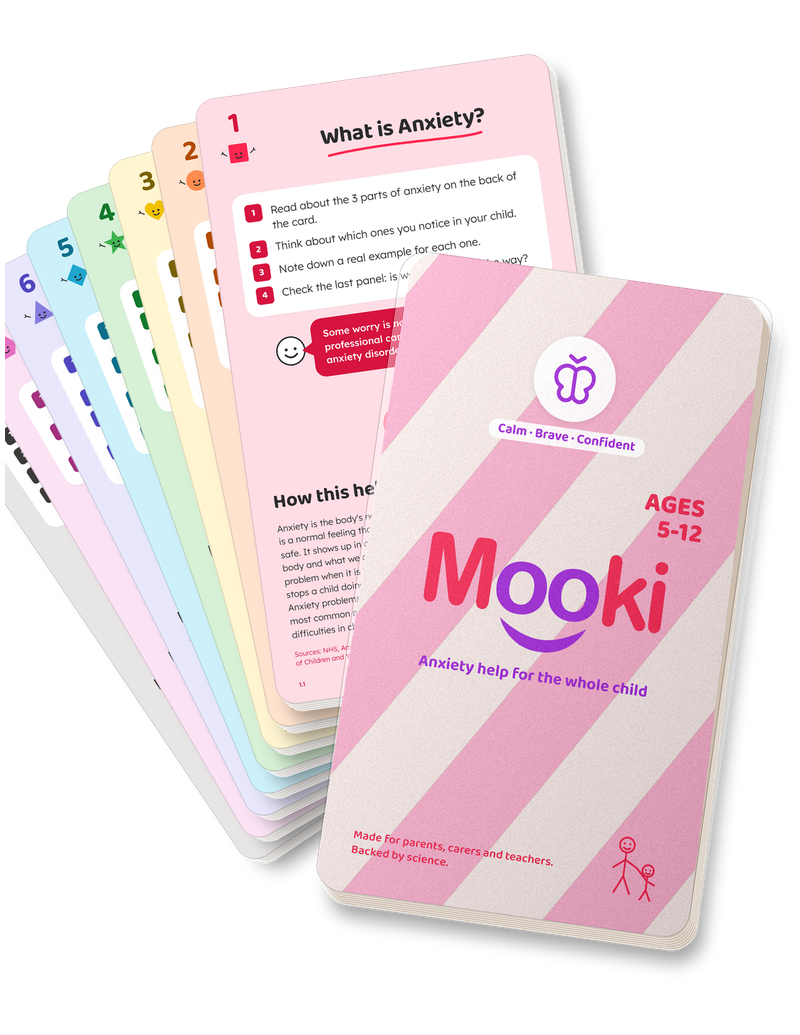
Worry Thermometer, Body Signals and Brave Ladder from the Mooki Anxiety deck each have a child worksheet on the back. They are three of 56 ten-minute activities to use on a tablet or print.
Instant download · use on a phone or tablet, or print and fill in at home or school
How to use anxiety worksheets well
- Go at your child’s pace. Some children like to write, others prefer to draw or have you write for them.
- Stay curious, not corrective. There are no wrong answers on a worry sheet.
- Keep them together. A folder becomes your child’s own anxiety workbook, showing how far they have come.
- Praise effort. “You worked really hard to name that worry” means more than praise for a neat sheet.
- Share with school. A body map or thermometer can help a teacher understand your child’s signs.
For younger children aged 5 to 7, use mostly pictures and keep it to one sheet at a time. Children aged 8 to 12 can often fill in sheets on their own and then talk them through with you.
Free resources we checked
These are real, free resources from trusted organisations. We checked each one before linking.
- Parent and Carer Anxiety Workbook from NHS Lothian CAMHS. A free PDF for parents with body signs, a step plan for facing fears and a worry box idea.
- Anxiety at Home info sheets on HeretoHelp, written by Anxiety Canada (the charity closed in 2025, but the sheets are still online). Practical guides on reassurance, bravery and routines.
- Rewarding Bravery, a sheet in the same series about setting up a simple points and reward plan for brave steps.
- Tackling student anxiety from Mentally Healthy Schools, run by the Anna Freud centre. A guide for school staff working with pupils aged 5 to 16.
- YoungMinds parents guide to anxiety, with ideas for worry boxes, calming activities and getting help.
When a worksheet is not enough
Worksheets are a helpful everyday tool, but they do not replace professional help. If your child’s worries are strong, last for weeks, or stop them going to school, sleeping or seeing friends, talk to your GP in the UK or your pediatrician in the US. Your child’s school can help too: in the UK, speak to the class teacher or SENCo, and in the US, the school counselor or school psychologist.
The bottom line
Simple anxiety worksheets for kids give worries a shape, a size and a plan. Start with one sheet, such as a body map or worry thermometer, keep it short and playful, and build a folder over time. Small, regular steps like these help children feel more in control of their worries.