
If your autistic child speaks few or no words, or struggles to get words out when stressed, this guide explains AAC devices for autism and simpler low-tech options, clears up common myths, and shows you how to start at home this week.
Every child has things to say. AAC gives them more ways to say them. You may have heard the term from a speech therapist or another parent and wondered where to begin. Let’s take it step by step.
What is AAC for autism?
AAC stands for augmentative and alternative communication. It means any way of communicating that adds to speech or replaces it. The Royal College of Speech and Language Therapists describes AAC as an approach that helps people communicate more clearly and easily.
“Augmentative” means it adds to speech a child already has. “Alternative” means it is used instead of speech. Many autistic children use both, depending on the day.
AAC is not only for children who never speak. The National Autistic Society explains that some autistic people who usually talk lose speech for a while when they are overwhelmed, stressed or exhausted. AAC can help then too.
Types of AAC systems for autism
AAC is often grouped into no-tech, low-tech and high-tech options. The American Speech-Language-Hearing Association (ASHA) gives a helpful overview.
No-tech: using the body
- Gestures and pointing
- Facial expressions
- Signing, such as Makaton or British Sign Language in the UK, or American Sign Language in the US
Low-tech: paper and pictures
- Picture cards your child can hand to you to ask for something
- Communication boards with pictures or symbols for common words like “more”, “stop”, “help” and “drink”
- Picture exchange systems, where a child gives a picture to get what they want, then later builds short sentences. PECS is the best known.
- Visual timetables and “now and next” boards to show what is happening
- Letter boards and writing for children who can spell
High-tech: AAC devices and apps
- AAC autism apps on a tablet, where your child taps a symbol and the device speaks the word
- Dedicated speech-generating devices, which are tablets built only for communication
- Simple buttons that play one recorded message, such as “I want a turn”
There is no single best system. RCSLT notes that the right AAC depends on the person and may change over time. Many families use a mix, such as a tablet at home and a laminated board at the park.
Myth: “AAC will stop my child learning to talk”
This is the worry parents raise most often, and it is understandable. The good news is that it is not supported by research.
ASHA says research does not support the idea that AAC stops a child from talking or slows language development. The American Academy of Pediatrics agrees. Its guide to speech and language therapy for autistic children says AAC does not keep children from learning to talk, and there is some evidence it may encourage speech.
Here are a few other myths, and what is true.
- “My child needs to be older first.” ASHA says there are no skills or milestones a child must reach before AAC can help. Even toddlers can use pictures.
- “AAC is a last resort.” AAC works best when it is offered early, alongside other support.
- “If they can say some words, they don’t need it.” Many children talk in calm moments and need another way when upset.
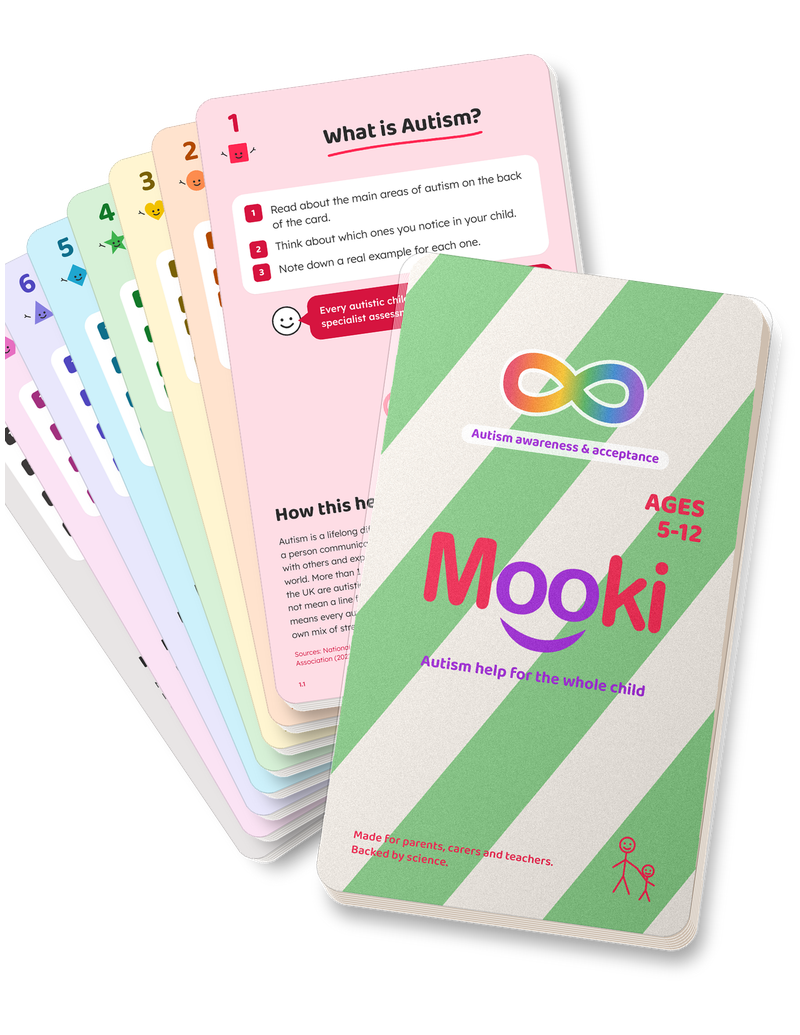
Want visual prompts that make communication easier?
Mooki's Now and Next, Visual Timetable and Understanding Language cards give you ready-made visual supports to use alongside AAC. Each is one of 56 ten-minute activities in the Autism deck.
Instant download · use on a phone or tablet, or print and fill in at home or school
How to start AAC at home
You do not need an expensive device to begin. Start small, keep it fun and put the pictures where life happens.
- Pick five useful words. Think about what your child wants most: “more”, “stop”, “help”, “drink” and a favourite snack or toy.
- Make simple cards. Use photos of the real objects at first. Clear symbols work well too.
- Model, model, model. Point to or tap the symbol yourself as you speak. “Do you want more bubbles?” This is called modelling, and it is how children learn any language.
- Don’t test. Avoid “Show me ‘more’.” Just use the cards naturally and give your child time.
- Respond quickly. When your child uses a card, give them what they asked for. This shows communication works.
- Keep it everywhere. Put a board on the fridge, in the car and in the bag.
Try it today: a 10-minute bubble game
- Get a pot of bubbles and one card that says “more”.
- Blow a few bubbles and stop. Wait and watch.
- Tap the “more” card and say “more!” Blow more bubbles straight away.
- Repeat. After a few rounds, pause a little longer and hold the card near your child.
- If your child touches it, reach for you, or makes a sound, treat it as a request. Celebrate with more bubbles.
- Stop while it’s still fun, and try again tomorrow.
For teachers: moving a child from PECS to an AAC device in Reception
Many children start school using PECS (the Picture Exchange Communication System). According to Pyramid Educational Consultants, who developed PECS, some children go on to develop speech and others move on to a speech-generating device. If your Reception (kindergarten) pupil is ready for a device, these steps help:
- Decide together. Agree the move with the child’s speech and language therapist (speech-language pathologist in the US) and parents. Don’t change systems alone.
- Keep the same symbols. Set up the device with the pictures and words the child already uses in their PECS book, in the same places where possible.
- Run both side by side. Keep the PECS book available while the child learns the device, so they never lose their voice.
- Model, model, model. Touch the device yourself as you talk: “I want snack”, “more bubbles”. Children learn AAC by seeing others use it.
- Start with strong wants. Use the device first for things the child really wants, like snack, a favourite toy or a game.
- Use it all day. Bring the device to carpet time, play, lunch and the playground, not just to one-to-one sessions.
The Offer Choices and Visual Timetable cards in the Mooki Autism deck, and the Model and Expand card in the Mooki Speech and Language deck, give you ready-made ways to practise in class.
Working with your speech therapist: UK and US
A speech professional can assess your child and help choose the right system. They are called a speech and language therapist (SLT) in the UK and a speech-language pathologist (SLP) in the US.
In the UK
Ask your GP, health visitor or your child’s SENCo for a referral to NHS speech and language therapy. The RCSLT explains that you can also contact your local NHS service and refer your child yourself. Communication support can be part of SEN support at school, and some children have AAC written into an education, health and care plan. For more complex needs, specialist NHS AAC services may assess for high-tech devices.
In the US
Talk to your pediatrician about a speech-language evaluation. Under IDEA, children under three can get support through early intervention. Older children can have AAC and assistive technology included in their IEP. A school-based SLP can help make sure the device goes to every lesson, not just therapy.
If you’re worried about your child’s communication, talk to your GP or paediatrician, or your child’s school.
The bottom line
AAC gives your child a voice now, without taking away the chance to speak later. Start with a few words, model often and keep it playful. Every way your child communicates is real communication, and it deserves to be heard.